Monday, October 13, 2008

The Cure


A+

Directed by Kiyoshi Kurosawa

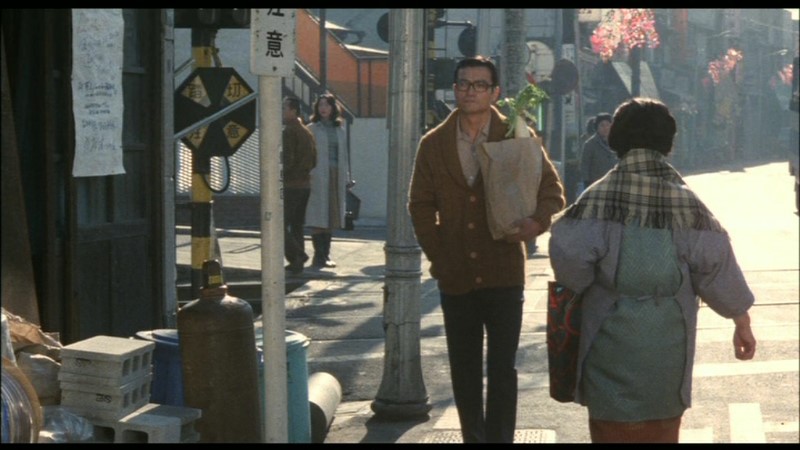
"The Cure" is a truly outstanding thriller/horror film from a truly outstanding director, Kiyoshi Kurosawa, whose film credits include such gems as "Bright Future" and the recent "Tokyo Sonata." "The Cure" is, in my opinion, probably Kuroawa's most fully realized work, as it displays all of his strengths as a filmmaker in stunning display, resulting in a pitch perfect, deeply intelligent film that blurs the boundaries between thriller and psycho-horror.

Director Kenichi Takabe, a detective in Tokyo, is investigating a string of seemingly related murders commited by unrelated perpetrators for no apparent reasons. The only common element linking the murders are brief conversations they had with a mysterious young man, a fact discovered by Takabe which puts him in dangerous proximity to forces he may not be ready to deal with...or even comprehend. (Sorry, I had to.)

Any more hashing out of the plot details would probably ruin all of part of the film so I'll just skip right ahead to praising it instead. Like most Kurosawa movies, "The Cure" is extremely obligue in the way it tells its story, requiring that the viewer figure out the ending on their own or, as I did, via the help of IMDB's message boards. When you finally do figure out what's going on in "The Cure," the revelation is satisfying and powerful all at once, the rarest of feelings when it comes to film endings. Kurosawa is an extremely talented filmmaker and script writer and his ability to weave together an intriguing story that still makes sense and delivers the goods in its third act is basically unparralled by his contemporaries, simply because he possesses the unique ability to construct stories which can only be resolved through not only actively paying attention to the film itself but also reflecting on it for hours, maybe even days, afterwards. In this respect, a film like "The Cure" is a puzzle that is far more enjoyable than films like "Memento," which presents a puzzle that, although enjoyable is a bit too easy to figure out, and "Mullhollnd Drive," which seems to be complicated just for the sake of it.

Tuesday, October 7, 2008

The Right Stuff


A

Directed by Philip Kaufmann

Philip Kaufmann's under appreciated box office bomb stands as one of the most entertaining and expansive American films of 1980's and is one of the very few examples of a film that is markedly better than the book that inspired it (Oh yeah, Tom Wolfe fans...I went there). I massive failure upon its release in theaters, "The Right Stuff" just goes to prove that American filmgoers have no idea what the hell a good movie actually is.


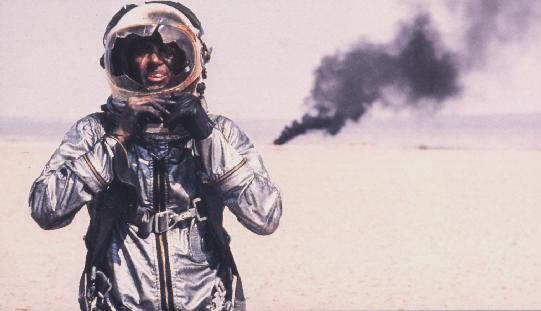
Based loosely off of Tom Wolfe's book of the same name, "The Right Stuff" opens with badass Chuck Yeager trying to break the sound barrier which, obviously he does, even though he is hounded by a broken risk and piloting an aircraft that looks like a giant dart. Following his feat, a number of high profile test pilots begin converging on Muroc Army Air Field, attempting to break the next big piloting barrier.

At the same time, in a far away land, the evil Soviets launch the first sattelite into space. American officials are rightfully pissed and decide to kick the Space Race into full gear, sending a couple of their men down to Muroc to recruit test pilots with "The Right Stuff" for the job. The rest of the film follows the training and eventual missions of such space luminaries as John Glenn, Virgil Grissom and Alan Shepard in their quest to show the Soviets who was boss.

The film makes a number of rather controversial claims, including that Virgil Grissom panicked in his capsule upon splashdown and blew open the capsule's hatch, effectively sinking it and almost drowning him when his spacesuit filled with water. This version of the facts is certainly debatable and makes Grissom appear fairly yellow in hindsight. On the flip side, the film makes Chuck Yeager look like the biggest badass to ever walk the face of the earth, basically implying that had Yeager not flatly refused NASA's offer to take part in their plans he would have been the first American in space. When considering Yeager's track record, it certainly does seem difficult to deny this, but again, it's all quite debatable. The point here isn't to attack the accuracy of "The Right Stuff" but simply to point out that along with being visually stunning and boasting an array of great performances, "The Right Stuff" is also enthralling and gripping in the way good historical epics are, and make no mistake, "The Right Stuff" certainly is an epic and still stands as probably the finest film on the Space Age ever made.

It is a shame that Kaufman's film wasn't more succesful at the box office because "The Right Stuff" is one of the rare films that is at once entertaining, intelligent, and perceptive, kind of like a Tom Wolfe book, really.

Chiefs

B-

Directed by Daniel Junge

The sport documentary/social commentary film is a well worn cinematic standard which often produces satisfactory results. The biggest problem with this type of documentary, however, is that any such film, regardless of the sport, will invariably be compared to "Hoop Dreams" which was not only one of the finest American documentaries ever produced but probably one of the best American films period of the last two decades (yet the Academy felt fit to bypass it in favor of some piece of crap no one remembers anymore. Way to go, Hollywood!) Indeed, "Hoop Dreams" looms large in the world of sports documentaries and even moreso Hoops documentaries which leaves many viewers, myself included, watching a rather good little film like Chiefs waiting for the heartbreaking moment when we see the main characters father play a few minutes of pickup ball with his son before heading off to buy a crack rock in plain sight. Call it a case of chronic unrealistic expectations.

"Chiefs" follows two seasons of ball on a small native reservation in Wyoming. The documentary follows a number of players, all of whom have different personalities, different playing styles, and different views about life on the reservation. The film is a fairly straightforward sports documentary and follows the well trodden path of sports documentaries which mix sports and social issues and their impact on one another. This almost always make for some interestingg viewing and this is certainly the case in "Chiefs" insofar as we can palpably see the importance of basketball in keeping alot of kids motivated, focused, and ultimately sane on a reservation which holds rather bleak prospects for many of these young men. The most gratifying aspect of "Chiefs," however, is the filmmakers ability to present life on the reservation simply as it is, in all its complexity and with all its problems, without overreaching and delving into preachiness on the plight of America's native population. Ultimately, "Chiefs" is very hopeful about the potential for Native youths to pull themselves out of poverty and succeed in life, something that is quite refreshing indeed.

Wednesday, September 17, 2008

Rescue Dawn


B-

Directed by Werner Herzog

One of my favorite documentaries of all time is Les Blank's "Burden of Dreams" which documents Werner Herzog attempting to film his epic "Fitzcarraldo" which tells the story of an opera enthusiat attempting to build an opera house in the middle of the Amazon. Throughout the documentary, it becomes hilariously obvious how much of a crazy artist Herzog actually was at the time, demanding that scenes be filmed in the most difficult conditions possible, at the risk of everyone's health and sanity. This Herzog is, by all accounts, largely dead and buried, having been replaced with a tamer, more gentle Werner who is now interested in making films that straddle the line between artsy and commerically viable. "Rescue Dawn" is probably the best example of this new Werner, a film that is fronted by Hollywood superstar Christian Bale and is surprisingly conventional in almost every respect.

"Rescue Dawn" tells the story of pilot Dieter, an American whose plane is shot down while flying a mission over Laos. After evading capture for a few days, he is finally nabbed by the local guerillas and brought to a jungle prison where he joins a number of other American prisoners who, Dieter finds out to his horror, have been held there for years. Being a man of action, Dieter almost immediately attempts to hatch an escape plan, an idea which is met with skepticism by his cellmate Duane and utter fear by Duane, a prisoner who is convinced that their release is imminent. The film then focuses on Dieter's attempts at hatching a viable escape plan and at the same time convincing his co-prisoners to go along with it.

Although conventional to a tee, "Rescue Dawn" benefits from strong directing by Herzog and great acting by Bale, Bill Zhan, and Jemery Davies, all of whom do their best to convey the hardships of living with basically no food in awful conditions as well as the psychological toll of being held against your will, unaware of when and if you will ever be released. The film is extremely succesful in establishing intrigue not just in regards to Dieter eventual escape but also in his rapport with his cellmates, many of whom are torn between following Dieter or ratting him out to the guards. "Rescue Dawn" does, however, suffer simply from being ultra-conventional, content with giving us the story we all expected without even a few surprises. In some ways it's a blessing that Herzog simply delivers a film that is enjoyable, intense, and exciting without delving into the politics of the time or trying to wax philosophical on the deeper meanings of armed conflict, but at the same time I expected something more from Herzog who, despite his reputation as a crazy director, is nonetheless immensely talented.

Thursday, September 4, 2008

Vengeance is Mine


B+

Directed by Shohei Imamura

The great Shohei Imamura can never be accused of making half-assed films. All of Imamura's cinematic offerings are ambitious, complex, and painstakingly detailed, all qualities that have a distinctly double edged quality to them. In "Vengeance is Mine," Imamura strives so hard for perfection that an otherwardly brilliant character drama is reduced to a stil brilliant but just really, really, really overlong film.

"Veangeance is Mine" follows the crime spree of Iwao Enokizu (played brilliantly here by the great Ken Ogato) as he makes his way through the Japanese countryside, piling up the body count for seemingly no reason whatsoever. The story itself jumps around from his interogation to crucial moments in his life, from his wedding to a woman he eventually abandons to his numerous romantic conquests to his numerous kills and their ramifications on his day to day life. The film is told through a complex series of flashbacks and requires a fair amount of dediction to follow the course of the story since the action skips around from place to place and from one era to the next. Watching Iwao maneuver his way through life, manipulting individuals and killing without a conscience is, to say the least, creepy, but also fascinating in a morbid sort of way.

"Vengeance is Mine" like most of Immamura's films, deals with a marginalized, criminal individual living on the fringes of society, and simply sits back and watches how said individual lives. As opposed to some Immamura films, such as the wonderful "The Eel," where his protaganist, even though a criminal, is imbued with a sense or morality and decency, the hero of "Vengeance is Mine" is buoyed neither by any type of moral obligation to his family or to others and seems to opperate completely outside the bounds of "normal" human behavior. The chracter sketch that results is a fascinating one and is worth watching if nothing else than for the morbid pleasure of watching someone live life with no real moral qualms, interested only in his own survivial and satiating his most basic needs.

The genius behind "Vengeance is Mine" is undeniable and Immamura's legacy as a premier filmmaker is already well established both in Japan and abroad. Despite this, Immamura's tendency to piece together extremely disjointed films that lack any real moral core (this is a debatable stament, I know) has always left me feeling somewhat cold. My favorite Immamura film, the above mentioned "Eel," appealed to me because the main character, although attempting to remove himself from society following a vicious crime, nonetheless found himself compelled to assist those around him in their time of need, leading to a film which ended with an almost shockingly un-Immamura sense community and of the value of compassion between humans. This type of feeling was altogether lacking from "Veangeance is Mine" which made the film, for me at least, interesting without being emotionally resonent.


Thursday, August 28, 2008

Love Ghost

F

Directed by Kaziyuki Shibuya

I scooped up this bad boy when browsing through the Fantasy/Horror section at the BANQ. The great thing about the BANQ, as I have already mentioned, is that their DVD library includes a number of films I have NEVER heard of which means that I can't bring a preconceived bias towards them and am thuis completely surprised by what I see when I pop them into the DVD player at home. Sometimes this results in a pleasant surprise, sometimes in a nasty one. "Love Ghost," unfortunately, falls squarely in the latter category.

Kazuko is a young girl who returns to her native village and enrolls in its local high school where she immediately reconnects with her childhood friend and possible lifetime crush, Ryusuke. Her arrival sparks the interest of local hunk (whose name I have since forgot but whose generic qualities really absolve me from any responsibility to remember it and pass on the information to the reader) whose affections in tujrn draw the ire of a number of Kazuko's classmates who, uninterested in hedging their romantic bets, all have crushes on the above mentioned stud. This messy move hexagon (or is it octagon) leads to a number of suicides which may have been spurred on by the mysterious shrine which sits in from of the school and whose appearance is always duly announced by spooky music. Meanwhile, a mysterious boy in black appears once in awhile, usually in conjunction with someone's death, and Kazuko's mom beging to go crazy.

Pretty much everything about this film is bad, from the acting of the lead, which is Bollywood-ish in its lack of range, to the gigantic holes in the plot to the fact that the mysterious boy in black's identity is revealed almost immediately due to poor camerawork (you will see what I mean if you ever experience "Love Ghost"). Despite this, the film inexplicably goes through moments where the DP's body was obviously was taken over by the soul of Christopher Doyle, resulting in moments of stunningly beautiful cinematography that vanish almost as soon as they appeared. This alone is no reason to actually sit down and take the time to watch "Love Ghost" though, so I emphatically counsel everyone to stay away from this effort unless you're in the mood for wasting a couple hours of your life.

Sunday, August 24, 2008

Be With Me


A

Directed by Eric Khoo

Movies about the disabled have become unfortunately best known for their heavihandedness and tear-jerking proclivities moreso than anything else. True stinkers such as "I Am Sam" come to mind, movies that are more interested in making a play for Oscar gold than in communicating anything about the disabilities their characters are afflicted with. This is fortunately not the case with Singaporean director Eric Khoo's marvelous "Be With Me."

"Be With Me" is an elliptical film that loosely interweaves four stories of love together, all of which show the vastly different forms love takes, from unrequited love to broken love to the rarest of all loves, the type that lasts a lifetime. These stories are focused around characters as disparate as a lonely and overweight night watchman and a young girl who is jilted by her lover, but the film's main focus revolves around the story of a blind and deaf woman writing the story of her life. Although the storylines here may sound like Gabriel Inniratu meets Nicolas Sparks, "Be With Me" is a subdued, meditative film that treats its characters seriously and handles its subject matter, both the heavy and the light, with perfect care, letting the stories tell themselves in a way that allows for a more powerful impact than any sweeping score, overwrought performance or other emotional manipulation usually featured in films about the disabled. Theresa Chan, the woman on whose life the film is based, actually plays herself in the film so there is no need for over the top acting. Chan's story is both truly uplifting and life affirming in the best possible way in the sense that Chan, even though afflicted with the inability to hear or to see, nonetheless finds the will to not only go through life but enjoy living as well. At one point Chan poignantly remarks that her disability has kept her from seeing or hearing all the beautiful things in the world but it has also kept her from seeing or hearing all the ugly things as well.

It is very difficult to convey how succesful this film is in soliciting an emotional response without trying to wilfully ply one out of its audience but it must be said that this is the supreme achievement of Khoo's film. The only other film I have ever seen that dealt with the disabled with the same warm, respectful, and non-manipulative approach was "Oasis" by director Lee Chang Dong. Both films knew how to toe the line between soliciting an appropriate emotional reaction from their audience and showing respect towards their subject matter and in both cases the end result were films of devastating emotional impact.

Friday, August 22, 2008

Tokyo Eyes


C

Directed byJean Pierre Limousin

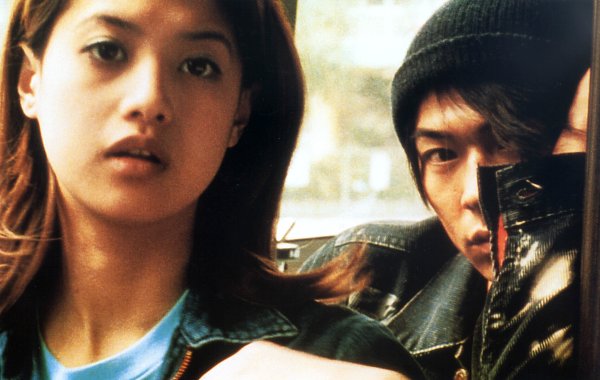
I had my beloved girlfriend download "Tokyo Eyes" (which appears to be harder to purchase on the open market than a nuclear warhead) mainly because the score was produced by Xavier Jamaux, the same guy who did a wonderful job as half of the team which produced the soundtrack for Johnnie To's "The Sparrow." Unfortunately for me, Jamaux's work in "Tokyo Eyes" is pretty unnoticeable and the film itself, despite some bright spots and overall solid acting by the films leads, would be forever relegated to the dustbin of my memory if I didn't take the time to document my watching it here.

"Tokyo Eyes" tells the story of Four Eyes, a local criminal who goes on a shooting spree around Tokyo which is noticeable not for its violence but for the perpetrators horrible aim, seeing as how how misses everyone of his targets, causing them nothing more than a scare. Hinano, a local hairdresser, becomes fascinated with Four Eyes' crimes and at the same time meets a mysterious, attractive youth on the subway. Wondering who he is, aren't you?
The story follows a predictable course as the two young ones court each other in a rather PG sort of way, culminating with Hinano's discovery that something is remarkably similar between Four Eyes and her new boyfriend.

"Tokyo Eyes" suffers greatly from the lack of a script the overall lethargy of its narrative. There is nothing wrong with a slow paced film, as I've always been quick to remind anyone who will listen, but the slowness has to bring something to the table, be it a meditative quality, or a particular mood that the filmmaker is going for. "Tokyo Eyes" just seems to be slow moving because it has nowhere to go, a small little picture drifting aimlessly towards its foregone conclusion. Another important flaw that "Tokyo Eyes" as well as many other Asian films in general and contemporary Japanese films in particular suffer from is in their seeming disinterest in adding any type of structure to the film's narrative. I have felt that Hollywood films, seemingly forever, have suffered from being too explicit, not allowing the picture to tell the story but relying rather on the script to tell it instead. Many asian films, such as "Tokyo Eyes" (even though it was directed by a frenchman) suffer from the completely opposite problem, namely that they seemingly don't feel the need to ever give their story some backbone or direction. The result is often maddeningly vague films that aim at establishing a meditative or melancholy mood but often end up simply being instantly forgettable.


Thursday, August 21, 2008

The Bow


A

Directed by Kim Ki-Duk

Even though I have not always enjoyed Kim Ki-Duk's films I still hold all of them in great regard since they are all inbued with the same unbelievable attention to detail and a skill for observing human interaction that is second to none in contemporary film. Kim's films are almost always slow, meditative affairs that revolve around almost anecdotal plot lines and feature a noticeable absence of dialogue, all elements that mask the often multilayered interactions that go on between Kim' characters. In this respect, "The Bow" is probably Kim's most fully realized work, moreso than even "3-Iron," or "Spring, Summer, Fall, Winter...and Spring," as it boasts layers of fascinating interaction between the films main protoganists.

"The Bow" takes place entirely on a rickety fishing barge owned by an old man and his daughter, who he plans to marry away when she turns 17. The pair seem entirely content with their spartan existence on the boat which they rent out to mainlaind anglers wishing for a few days on the open sea, although the father's overprotectiveness of his daughter often borders on the insane as he discourages their advances towards the girl with warning arrow shots from his trusty bow. As the film wears on, we sense something may be amiss in the relationship between father and daughter, a suspicion thta is confirmed when a young mainlainder begins to take an interest in the old man's daughter.

Without ruining more of the film than I already have, let me say that Kim ki-Duk plays around with some rather explosive and lurid material here but succeeds in telling in a story that, despite its subject matter, never seems exploitative or cheap. Rather, "The Bow" is a understated and at times ravishingly beautiful film that succeeds in setting up an "isolated and marginal world" as koreanfilm.com's Darcy Paquet put it, and allowing the interactions between the film's character to provide the intrigue. Unlike Paquet and others who found the film to be lacking in the areas where "Samaritan Girl" and "3-Iron" succeeded, I found that Kim was much more honest in his depiction of the relationships in "The Bow" than he was in either of the above films, both of which, although enjoyable in their own right, were either too gimmicky (3-Iron) or too obvious in their emotional manipulation (Samaritan Girl).

Tuesday, August 12, 2008

Pistol Opera


B-

Directed by Seijun Suzuki

Seijun Suzuki's renown was originally built mostly on his constant squabbles with Tokyo film giant Nkkatsu studios where he frequently butted heads with management, producing wild, map cap filmd that were seen as disgraces by the suits at Nikkatsu but many of which have now become seminal films in the history of Japanese ciname. Suzuki's wild, uncompromising style was largely borne out of his attempts at causing grief to Nikkatsu and resulted in some great stuff such as "Tokyo Drifter" and "Branded to Kill." His later works, of which "Pistol Opera" is a part, are sort of a mixed bag but contain a fair amount fo what made Suzuki's original films so good.

"Pistol Opera" follows Miyuki "Stray Cat," Minazuki, #3 ranked assassin in the hilariously straight forwardly named "Assassins Guild" in her attempts to both survive the attacks of other guild members and claim the #1 spot for herself. The film works as a series of showdowns between Stray Cat and a motley crew of assassins with names such as "Hundred Eyes" and "Painless Surgeon." Suzuki's absurdist style is on full display here and the smilarities between "Pistol Opera" and his earlier works is not hard to draw. Indeed, it appears that Suzuki has not felt the need to reform himself later in his career or rather offer films that diverge significantly from the works which made him famous in the first place. Although "Pistol Opera" suffers a bit from the fact that is just comes off as a newer, more modern version of some of Suzuki's older films, it remains nonetheless that "Pistol Opera" is alot of fun and features from uniquely Suzuki-esque moments that are both visually exciting, absurd, and hilarious at the same time.

Addicted


B

Directed by Park Yeon-Hoon

I frankly have no idea how the National Library got their paws on this obscure piece of Korean film but I decided to give "Addicted" a watch despite the fact that the cover appeared to be advertising a Korean Soap.

"Addicted" tells the sordid tale of two brothers, Dae-jin and Ho-jin, who live together in the same house along with Ho-jin's wife Eun-su. Ho-jin and Eun-su's marriage seems to be the stuff of legend but is tragically cut short when Ho-jin, on the way to Dae-jin's amateur car race, gets T-Boned by a truck, putting him in a coma. Unbelievably, Dae-jin also falls victim to a horrible crash down at the track and he too ends up in a coma. Not a very good day for the brothers...Dae-jin miraculously awakes from his coma to find Ho-jin in a vegetative state and
his wife understandably crestfallen. When Eun-su takes Dae-jin back home, he isn't quite the same, however. Rather, Dae-jin begins to show a startling resemblence to Ho-jin...

Films focusing on mistaken or alterered identities are a genre into themselves are most are not very good. Although "Addicted" doesn't really break any new ground in the genre, suffering not only from a rather weak premise for Dae-jin's new identity asd well as a very predictable outcome to the film, there is nonetheless a lot of value in "Addicted," mostly in the way Park Yeon-Hoon chooses to move away from the sensational and embrace the understated in his handling of the story. The film also offers an interesting perspective on the age old philosphical question of the difference between soul and body and if the value fo a person resides in one or the other or both together.


Monday, August 4, 2008

Night at the Museum


D+

Directed by Shawn Levy

Shawn Levy's super formulaic Ben Stiller vehicle is a pretty bad movie in many respects, but it's totally innoffensive and at times amusing so there is no point in lambasting it.

Stiller plays a hapless, divorced entrepreneur whose ideas never get off the ground, putting him in dire financial straights and prompting his ex-wife to threaten to take custody of their child if he doesn't get his act together. In an effort to keep his son, (Stiller) takes a job as a night watchman at the New York museum of Natural History only to find out that, surprise surprise, the museuems denizens come to life at night! Adventure ensues.

One of the problems with Night at the Museum, aside from its pedestrian pace and paint by numbers plot is the fact that any film which promises to have the its main character locked up in a natural history museum whose occupants come alive at night has basically bit off more than it can chew. Indeed, watching miniature Octavian and some cowboy played by Owen Wilson duke it out, although amusing, didn't float my boat when I could have seen a FULL SIZED Julius Ceasar face off against an equally full sized Adolf Hitler or Erik the Red. Seriously, the possibilities are endless and basing a film on such a premise is opening a Pandora's Box...of disappointment.

Although this film certainly deserves its "D," I can't with a good conscience, totally savage it because it means well and there are genuinely amusing moments sprinkled in throughout. "Night at the Museum" is a fine movie to toss on if your babysitting or otherwise trying to keep infants asleep, and I therefore recommend it for such times.

Sunday, August 3, 2008

Syriana


C+

Directed by Stephen Gaghan

"Syriana," or as I like to call it, "Traffic: The Middle Eastern Adventures" is writer/director Stephen Gaghan's attempt at high brow political commentary and, although he isn't entirely unsuccesful at producing a sleek, entertaining film, the politics that buttress the film are as ridiculous and simplistic as Gaghan likely believed them to be timely and deep.

"Syriana" follows an elliptical, multi-character storyline in which a number of different subplots are interwoven until, as we might expect, they call come together at the end in a mostly unbelievable climax. I must say that this narrative device, which seems to be de rigeur in Hollywood these days as evidenced by such films as "21 Grams," "Babel," or the aforementioned "Traffic" has likely worn out its welcome. When a film needs to build most of its intrique around the question of how a number of disparate, seemingly unrelated storylines will meet, there usually isn't any real meat to the underlying story. "Syriana" is at least mildly succesful in stringing together a series of stories that don't seem that wildly unrelated even though, as mentioned before, the ultimate congress of these storylines likely caused more than a few raised eyebrows.

The biggest problem with Syriana is that its preachy policial message, namely that American multinational business interests are holding underdeveloped nations hostage to greed, is treated in the most hamfisted, semi-three dimensional way possible. In Gaghan's world political issues are black or white and the possibility that some type of nuance may exist in the relationship between business and domestic and foreign politics is given no more than a passing thought, leading to a film that comes to ridiculous conclusions about the nature of U.S. foreign policy and its relationship to business. According to Gaghan, profit for American big business is where the buck stops in terms of U.S foreign policy and what is good for Big Oil is seen as good for the Red White and Blue. Although this type of thinking will resonate profoundly with the young and impressionable youths of America's colleges, anyone with even a basic knowledge of American foreign policy will likely respond to "Syriana's" loaded poltical message with a certain amount of skepticism.

The Man Who Copied


C+

Directed by Jorge Furtado

"The Man Who Copied" is the rarest of rare cinematic breeds--the Brazilian Romantic Comedy/Heist flic, and as far as Brazilian Romantic Comedy/Heist flics go, it's probably the best one Ive ever seen. Oh wait, it's the ONLY one I've ever seen. In fact, it's the only Brazilian Romantic comedy OR heist flic I've ever seen. Maybe I need to start getting into Brazilian cinema...


"The Man Who Copied" is a young man by the name of Andre, who works as, you guessed it, a photocopier operator in a family run shop in Porto Allegre. He lives with his mom in a rundown two bedroom apartment where he spends his nights working on illustrations and spying on the beautiful Silvia, his love interest who lives several blocks away in a high rise apartment complex, through binoculars. Creepy.

Andre eventually works up the nerve to speak to Silvia and they begin an awkward relationship that is marred by Andre's disovery that Silvia's father is a crook and may be molesting her. Deciding that he needs to get Silvia out of Porto Allegre, he plans to marry her but lacking sufficient funds, concocts a rather rudimentary plan to rob an armored truck. Things, unsurprisingly, go wary and Andre is left in a spot of trouble.

"The Man Who Copied" is not at all an unpleasant cinemtic experience. The light, and very PG-esque, romance that develops between Andre and Silvia is endearing and fun to watch unfold, even though it doesn't have much ring of truth to it, insofar as life long romances rarely get started by the earnest yet illegal efforts of Peeping Toms. What dooms this film to mediocrity, however, si the lazy handling of the second part of the film where Andre carries out his "get rich quick scheme." The inevitable troubles he runs into get glossed over fairly quickly, leaving me with the impression that stealing $2 Million dollars from heavily armed guards is not only a pretty simple get rich quick scheme, but also a fairly safe one. Furthermore, the supporting cast around Andre and Silivia are almost inconsequential to the film and bring basically nothing to enrich the overall experience. The film is also one that clocks in at around 90 minutes but feels like it lasted 15. I have no trouble with brisk films, but there is certainly a difference between "brisk" and "thin."

Tuesday, July 29, 2008

The Dark Night


A+

Directed by Christopher Nolan

It is indeed rare that a film can not only meet the type of unbridled expectations the public had for "The Dark Night" but surpass them altogether. Christopher Nolan's latest chapter in the "Batman" series is head and shoulders above any previous "Batman" film, one of the best action films in recent memory and possibly the best superhero movie ever. Seriously.


"The Dark Night" is set in a Gotham that finally seems to be pulling itself up by the bootstraps and cleaning up its streets. The local mob bosses are feeling the squeeze as Batman has made their day to day lives increasingly difficult and the new DA, Harvey Dent, is threatening to garnish their millions in assets. Fearing that Dent may indeed rob them of their ill gotten gains, Gotham's mobsters hire a shady Hong Kong businessman to funnel the money out of the country. Batman flies off to Hong Kong to retrieve the mobsters banker only to return to city that is being thrown into chaos by the violent and unpredictable Joker who has made it his mission to throw Gotham into total choas. What follows is an elaborate cat and mouse game between Batman and The Joker that is not only visually awesome but resonates with truth in the way it treats the morality of its individuals.

I always feel stupid gushing about a film without restraint, but it isn't a stretch to say that "The Dark Night" is an almost flawless action film. This is an epic, engorssing film in the very best senses of the words, ressembling at times "the War of the Worlds" or "Heat" more than any of the previous Batman movies. The film's lenght, which at two hours and thirty minutes at first had me worried, flies by at an almost seemless pace bombarding viewers with scene after scene of jaw dropping action that basically beats any skepticsism into wordless submission. Some of the action sequences, most particularly the Joker's assissination attempt on Harvey Dent, are worth the price of admission alone and left me, and every onc else in the audience, on the edge of our seats. Beyond the film's action which is undeniably superb, "The Dark Night" boasts characters that are far removed from the semi three dimensional characters that are the norm in action films and even in most "serious" Hollywood fare. Chrisopher Nolan has taken a series that was often cartoonish and essentially geared towards younger audiences and breathed new life into it by infusing levels of psychological nuance into his characters that almost toally foreign to action films, let alone the "Batman" series. Bruce Wayne is no longer a suave but uncompromisingly honest superhero whose moral campus always lines up perfectly with the wishes of Gotham's residents or his even his own desires. Rather, Nolan has turned him into a tortured, almost reluctant superhero who at every step of the way must question his reasons for doing good in a world that is so evil and has put him face to face with The Joker, a villain that is governed by no morality whatsoever, no code of conduct or ethical creed and wants only to see chaos rule the day.

"The Dark Night" fully deserves whatever box office records it breaks and whatever accolades or awards it is given. I can only hope that the Academy, which often makes laughably poor decisions ("and this year's Oscar for Best Picture...Crash!) fully realizes that "The Dark Night" isn't just a riveting action film but a true masterpiece of the genre that boasts top flight actors giving in top flight performances, most notably Ledger whose performance as the Joker practically dominates the film. A monumental achievement and an action film of the first order, go out and see "The Dark Night" on the big screen if you haven't already. You'll regret it if you don't.