Thursday, August 28, 2008

Love Ghost

F

Directed by Kaziyuki Shibuya

I scooped up this bad boy when browsing through the Fantasy/Horror section at the BANQ. The great thing about the BANQ, as I have already mentioned, is that their DVD library includes a number of films I have NEVER heard of which means that I can't bring a preconceived bias towards them and am thuis completely surprised by what I see when I pop them into the DVD player at home. Sometimes this results in a pleasant surprise, sometimes in a nasty one. "Love Ghost," unfortunately, falls squarely in the latter category.

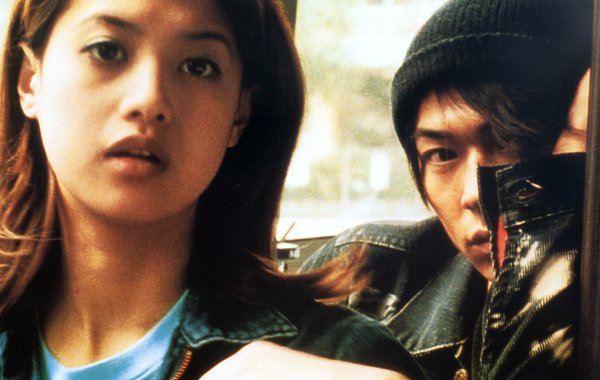
Kazuko is a young girl who returns to her native village and enrolls in its local high school where she immediately reconnects with her childhood friend and possible lifetime crush, Ryusuke. Her arrival sparks the interest of local hunk (whose name I have since forgot but whose generic qualities really absolve me from any responsibility to remember it and pass on the information to the reader) whose affections in tujrn draw the ire of a number of Kazuko's classmates who, uninterested in hedging their romantic bets, all have crushes on the above mentioned stud. This messy move hexagon (or is it octagon) leads to a number of suicides which may have been spurred on by the mysterious shrine which sits in from of the school and whose appearance is always duly announced by spooky music. Meanwhile, a mysterious boy in black appears once in awhile, usually in conjunction with someone's death, and Kazuko's mom beging to go crazy.

Pretty much everything about this film is bad, from the acting of the lead, which is Bollywood-ish in its lack of range, to the gigantic holes in the plot to the fact that the mysterious boy in black's identity is revealed almost immediately due to poor camerawork (you will see what I mean if you ever experience "Love Ghost"). Despite this, the film inexplicably goes through moments where the DP's body was obviously was taken over by the soul of Christopher Doyle, resulting in moments of stunningly beautiful cinematography that vanish almost as soon as they appeared. This alone is no reason to actually sit down and take the time to watch "Love Ghost" though, so I emphatically counsel everyone to stay away from this effort unless you're in the mood for wasting a couple hours of your life.

Sunday, August 24, 2008

Be With Me


A

Directed by Eric Khoo

Movies about the disabled have become unfortunately best known for their heavihandedness and tear-jerking proclivities moreso than anything else. True stinkers such as "I Am Sam" come to mind, movies that are more interested in making a play for Oscar gold than in communicating anything about the disabilities their characters are afflicted with. This is fortunately not the case with Singaporean director Eric Khoo's marvelous "Be With Me."

"Be With Me" is an elliptical film that loosely interweaves four stories of love together, all of which show the vastly different forms love takes, from unrequited love to broken love to the rarest of all loves, the type that lasts a lifetime. These stories are focused around characters as disparate as a lonely and overweight night watchman and a young girl who is jilted by her lover, but the film's main focus revolves around the story of a blind and deaf woman writing the story of her life. Although the storylines here may sound like Gabriel Inniratu meets Nicolas Sparks, "Be With Me" is a subdued, meditative film that treats its characters seriously and handles its subject matter, both the heavy and the light, with perfect care, letting the stories tell themselves in a way that allows for a more powerful impact than any sweeping score, overwrought performance or other emotional manipulation usually featured in films about the disabled. Theresa Chan, the woman on whose life the film is based, actually plays herself in the film so there is no need for over the top acting. Chan's story is both truly uplifting and life affirming in the best possible way in the sense that Chan, even though afflicted with the inability to hear or to see, nonetheless finds the will to not only go through life but enjoy living as well. At one point Chan poignantly remarks that her disability has kept her from seeing or hearing all the beautiful things in the world but it has also kept her from seeing or hearing all the ugly things as well.

It is very difficult to convey how succesful this film is in soliciting an emotional response without trying to wilfully ply one out of its audience but it must be said that this is the supreme achievement of Khoo's film. The only other film I have ever seen that dealt with the disabled with the same warm, respectful, and non-manipulative approach was "Oasis" by director Lee Chang Dong. Both films knew how to toe the line between soliciting an appropriate emotional reaction from their audience and showing respect towards their subject matter and in both cases the end result were films of devastating emotional impact.

Friday, August 22, 2008

Tokyo Eyes


C

Directed byJean Pierre Limousin

I had my beloved girlfriend download "Tokyo Eyes" (which appears to be harder to purchase on the open market than a nuclear warhead) mainly because the score was produced by Xavier Jamaux, the same guy who did a wonderful job as half of the team which produced the soundtrack for Johnnie To's "The Sparrow." Unfortunately for me, Jamaux's work in "Tokyo Eyes" is pretty unnoticeable and the film itself, despite some bright spots and overall solid acting by the films leads, would be forever relegated to the dustbin of my memory if I didn't take the time to document my watching it here.

"Tokyo Eyes" tells the story of Four Eyes, a local criminal who goes on a shooting spree around Tokyo which is noticeable not for its violence but for the perpetrators horrible aim, seeing as how how misses everyone of his targets, causing them nothing more than a scare. Hinano, a local hairdresser, becomes fascinated with Four Eyes' crimes and at the same time meets a mysterious, attractive youth on the subway. Wondering who he is, aren't you?
The story follows a predictable course as the two young ones court each other in a rather PG sort of way, culminating with Hinano's discovery that something is remarkably similar between Four Eyes and her new boyfriend.

"Tokyo Eyes" suffers greatly from the lack of a script the overall lethargy of its narrative. There is nothing wrong with a slow paced film, as I've always been quick to remind anyone who will listen, but the slowness has to bring something to the table, be it a meditative quality, or a particular mood that the filmmaker is going for. "Tokyo Eyes" just seems to be slow moving because it has nowhere to go, a small little picture drifting aimlessly towards its foregone conclusion. Another important flaw that "Tokyo Eyes" as well as many other Asian films in general and contemporary Japanese films in particular suffer from is in their seeming disinterest in adding any type of structure to the film's narrative. I have felt that Hollywood films, seemingly forever, have suffered from being too explicit, not allowing the picture to tell the story but relying rather on the script to tell it instead. Many asian films, such as "Tokyo Eyes" (even though it was directed by a frenchman) suffer from the completely opposite problem, namely that they seemingly don't feel the need to ever give their story some backbone or direction. The result is often maddeningly vague films that aim at establishing a meditative or melancholy mood but often end up simply being instantly forgettable.


Thursday, August 21, 2008

The Bow


A

Directed by Kim Ki-Duk

Even though I have not always enjoyed Kim Ki-Duk's films I still hold all of them in great regard since they are all inbued with the same unbelievable attention to detail and a skill for observing human interaction that is second to none in contemporary film. Kim's films are almost always slow, meditative affairs that revolve around almost anecdotal plot lines and feature a noticeable absence of dialogue, all elements that mask the often multilayered interactions that go on between Kim' characters. In this respect, "The Bow" is probably Kim's most fully realized work, moreso than even "3-Iron," or "Spring, Summer, Fall, Winter...and Spring," as it boasts layers of fascinating interaction between the films main protoganists.

"The Bow" takes place entirely on a rickety fishing barge owned by an old man and his daughter, who he plans to marry away when she turns 17. The pair seem entirely content with their spartan existence on the boat which they rent out to mainlaind anglers wishing for a few days on the open sea, although the father's overprotectiveness of his daughter often borders on the insane as he discourages their advances towards the girl with warning arrow shots from his trusty bow. As the film wears on, we sense something may be amiss in the relationship between father and daughter, a suspicion thta is confirmed when a young mainlainder begins to take an interest in the old man's daughter.

Without ruining more of the film than I already have, let me say that Kim ki-Duk plays around with some rather explosive and lurid material here but succeeds in telling in a story that, despite its subject matter, never seems exploitative or cheap. Rather, "The Bow" is a understated and at times ravishingly beautiful film that succeeds in setting up an "isolated and marginal world" as koreanfilm.com's Darcy Paquet put it, and allowing the interactions between the film's character to provide the intrigue. Unlike Paquet and others who found the film to be lacking in the areas where "Samaritan Girl" and "3-Iron" succeeded, I found that Kim was much more honest in his depiction of the relationships in "The Bow" than he was in either of the above films, both of which, although enjoyable in their own right, were either too gimmicky (3-Iron) or too obvious in their emotional manipulation (Samaritan Girl).

Tuesday, August 12, 2008

Pistol Opera


B-

Directed by Seijun Suzuki

Seijun Suzuki's renown was originally built mostly on his constant squabbles with Tokyo film giant Nkkatsu studios where he frequently butted heads with management, producing wild, map cap filmd that were seen as disgraces by the suits at Nikkatsu but many of which have now become seminal films in the history of Japanese ciname. Suzuki's wild, uncompromising style was largely borne out of his attempts at causing grief to Nikkatsu and resulted in some great stuff such as "Tokyo Drifter" and "Branded to Kill." His later works, of which "Pistol Opera" is a part, are sort of a mixed bag but contain a fair amount fo what made Suzuki's original films so good.

"Pistol Opera" follows Miyuki "Stray Cat," Minazuki, #3 ranked assassin in the hilariously straight forwardly named "Assassins Guild" in her attempts to both survive the attacks of other guild members and claim the #1 spot for herself. The film works as a series of showdowns between Stray Cat and a motley crew of assassins with names such as "Hundred Eyes" and "Painless Surgeon." Suzuki's absurdist style is on full display here and the smilarities between "Pistol Opera" and his earlier works is not hard to draw. Indeed, it appears that Suzuki has not felt the need to reform himself later in his career or rather offer films that diverge significantly from the works which made him famous in the first place. Although "Pistol Opera" suffers a bit from the fact that is just comes off as a newer, more modern version of some of Suzuki's older films, it remains nonetheless that "Pistol Opera" is alot of fun and features from uniquely Suzuki-esque moments that are both visually exciting, absurd, and hilarious at the same time.

Addicted


B

Directed by Park Yeon-Hoon

I frankly have no idea how the National Library got their paws on this obscure piece of Korean film but I decided to give "Addicted" a watch despite the fact that the cover appeared to be advertising a Korean Soap.

"Addicted" tells the sordid tale of two brothers, Dae-jin and Ho-jin, who live together in the same house along with Ho-jin's wife Eun-su. Ho-jin and Eun-su's marriage seems to be the stuff of legend but is tragically cut short when Ho-jin, on the way to Dae-jin's amateur car race, gets T-Boned by a truck, putting him in a coma. Unbelievably, Dae-jin also falls victim to a horrible crash down at the track and he too ends up in a coma. Not a very good day for the brothers...Dae-jin miraculously awakes from his coma to find Ho-jin in a vegetative state and
his wife understandably crestfallen. When Eun-su takes Dae-jin back home, he isn't quite the same, however. Rather, Dae-jin begins to show a startling resemblence to Ho-jin...

Films focusing on mistaken or alterered identities are a genre into themselves are most are not very good. Although "Addicted" doesn't really break any new ground in the genre, suffering not only from a rather weak premise for Dae-jin's new identity asd well as a very predictable outcome to the film, there is nonetheless a lot of value in "Addicted," mostly in the way Park Yeon-Hoon chooses to move away from the sensational and embrace the understated in his handling of the story. The film also offers an interesting perspective on the age old philosphical question of the difference between soul and body and if the value fo a person resides in one or the other or both together.


Monday, August 4, 2008

Night at the Museum


D+

Directed by Shawn Levy

Shawn Levy's super formulaic Ben Stiller vehicle is a pretty bad movie in many respects, but it's totally innoffensive and at times amusing so there is no point in lambasting it.

Stiller plays a hapless, divorced entrepreneur whose ideas never get off the ground, putting him in dire financial straights and prompting his ex-wife to threaten to take custody of their child if he doesn't get his act together. In an effort to keep his son, (Stiller) takes a job as a night watchman at the New York museum of Natural History only to find out that, surprise surprise, the museuems denizens come to life at night! Adventure ensues.

One of the problems with Night at the Museum, aside from its pedestrian pace and paint by numbers plot is the fact that any film which promises to have the its main character locked up in a natural history museum whose occupants come alive at night has basically bit off more than it can chew. Indeed, watching miniature Octavian and some cowboy played by Owen Wilson duke it out, although amusing, didn't float my boat when I could have seen a FULL SIZED Julius Ceasar face off against an equally full sized Adolf Hitler or Erik the Red. Seriously, the possibilities are endless and basing a film on such a premise is opening a Pandora's Box...of disappointment.

Although this film certainly deserves its "D," I can't with a good conscience, totally savage it because it means well and there are genuinely amusing moments sprinkled in throughout. "Night at the Museum" is a fine movie to toss on if your babysitting or otherwise trying to keep infants asleep, and I therefore recommend it for such times.

Sunday, August 3, 2008

Syriana


C+

Directed by Stephen Gaghan

"Syriana," or as I like to call it, "Traffic: The Middle Eastern Adventures" is writer/director Stephen Gaghan's attempt at high brow political commentary and, although he isn't entirely unsuccesful at producing a sleek, entertaining film, the politics that buttress the film are as ridiculous and simplistic as Gaghan likely believed them to be timely and deep.

"Syriana" follows an elliptical, multi-character storyline in which a number of different subplots are interwoven until, as we might expect, they call come together at the end in a mostly unbelievable climax. I must say that this narrative device, which seems to be de rigeur in Hollywood these days as evidenced by such films as "21 Grams," "Babel," or the aforementioned "Traffic" has likely worn out its welcome. When a film needs to build most of its intrique around the question of how a number of disparate, seemingly unrelated storylines will meet, there usually isn't any real meat to the underlying story. "Syriana" is at least mildly succesful in stringing together a series of stories that don't seem that wildly unrelated even though, as mentioned before, the ultimate congress of these storylines likely caused more than a few raised eyebrows.

The biggest problem with Syriana is that its preachy policial message, namely that American multinational business interests are holding underdeveloped nations hostage to greed, is treated in the most hamfisted, semi-three dimensional way possible. In Gaghan's world political issues are black or white and the possibility that some type of nuance may exist in the relationship between business and domestic and foreign politics is given no more than a passing thought, leading to a film that comes to ridiculous conclusions about the nature of U.S. foreign policy and its relationship to business. According to Gaghan, profit for American big business is where the buck stops in terms of U.S foreign policy and what is good for Big Oil is seen as good for the Red White and Blue. Although this type of thinking will resonate profoundly with the young and impressionable youths of America's colleges, anyone with even a basic knowledge of American foreign policy will likely respond to "Syriana's" loaded poltical message with a certain amount of skepticism.

The Man Who Copied


C+

Directed by Jorge Furtado

"The Man Who Copied" is the rarest of rare cinematic breeds--the Brazilian Romantic Comedy/Heist flic, and as far as Brazilian Romantic Comedy/Heist flics go, it's probably the best one Ive ever seen. Oh wait, it's the ONLY one I've ever seen. In fact, it's the only Brazilian Romantic comedy OR heist flic I've ever seen. Maybe I need to start getting into Brazilian cinema...


"The Man Who Copied" is a young man by the name of Andre, who works as, you guessed it, a photocopier operator in a family run shop in Porto Allegre. He lives with his mom in a rundown two bedroom apartment where he spends his nights working on illustrations and spying on the beautiful Silvia, his love interest who lives several blocks away in a high rise apartment complex, through binoculars. Creepy.

Andre eventually works up the nerve to speak to Silvia and they begin an awkward relationship that is marred by Andre's disovery that Silvia's father is a crook and may be molesting her. Deciding that he needs to get Silvia out of Porto Allegre, he plans to marry her but lacking sufficient funds, concocts a rather rudimentary plan to rob an armored truck. Things, unsurprisingly, go wary and Andre is left in a spot of trouble.

"The Man Who Copied" is not at all an unpleasant cinemtic experience. The light, and very PG-esque, romance that develops between Andre and Silvia is endearing and fun to watch unfold, even though it doesn't have much ring of truth to it, insofar as life long romances rarely get started by the earnest yet illegal efforts of Peeping Toms. What dooms this film to mediocrity, however, si the lazy handling of the second part of the film where Andre carries out his "get rich quick scheme." The inevitable troubles he runs into get glossed over fairly quickly, leaving me with the impression that stealing $2 Million dollars from heavily armed guards is not only a pretty simple get rich quick scheme, but also a fairly safe one. Furthermore, the supporting cast around Andre and Silivia are almost inconsequential to the film and bring basically nothing to enrich the overall experience. The film is also one that clocks in at around 90 minutes but feels like it lasted 15. I have no trouble with brisk films, but there is certainly a difference between "brisk" and "thin."

Tuesday, July 29, 2008

The Dark Night


A+

Directed by Christopher Nolan

It is indeed rare that a film can not only meet the type of unbridled expectations the public had for "The Dark Night" but surpass them altogether. Christopher Nolan's latest chapter in the "Batman" series is head and shoulders above any previous "Batman" film, one of the best action films in recent memory and possibly the best superhero movie ever. Seriously.


"The Dark Night" is set in a Gotham that finally seems to be pulling itself up by the bootstraps and cleaning up its streets. The local mob bosses are feeling the squeeze as Batman has made their day to day lives increasingly difficult and the new DA, Harvey Dent, is threatening to garnish their millions in assets. Fearing that Dent may indeed rob them of their ill gotten gains, Gotham's mobsters hire a shady Hong Kong businessman to funnel the money out of the country. Batman flies off to Hong Kong to retrieve the mobsters banker only to return to city that is being thrown into chaos by the violent and unpredictable Joker who has made it his mission to throw Gotham into total choas. What follows is an elaborate cat and mouse game between Batman and The Joker that is not only visually awesome but resonates with truth in the way it treats the morality of its individuals.

I always feel stupid gushing about a film without restraint, but it isn't a stretch to say that "The Dark Night" is an almost flawless action film. This is an epic, engorssing film in the very best senses of the words, ressembling at times "the War of the Worlds" or "Heat" more than any of the previous Batman movies. The film's lenght, which at two hours and thirty minutes at first had me worried, flies by at an almost seemless pace bombarding viewers with scene after scene of jaw dropping action that basically beats any skepticsism into wordless submission. Some of the action sequences, most particularly the Joker's assissination attempt on Harvey Dent, are worth the price of admission alone and left me, and every onc else in the audience, on the edge of our seats. Beyond the film's action which is undeniably superb, "The Dark Night" boasts characters that are far removed from the semi three dimensional characters that are the norm in action films and even in most "serious" Hollywood fare. Chrisopher Nolan has taken a series that was often cartoonish and essentially geared towards younger audiences and breathed new life into it by infusing levels of psychological nuance into his characters that almost toally foreign to action films, let alone the "Batman" series. Bruce Wayne is no longer a suave but uncompromisingly honest superhero whose moral campus always lines up perfectly with the wishes of Gotham's residents or his even his own desires. Rather, Nolan has turned him into a tortured, almost reluctant superhero who at every step of the way must question his reasons for doing good in a world that is so evil and has put him face to face with The Joker, a villain that is governed by no morality whatsoever, no code of conduct or ethical creed and wants only to see chaos rule the day.

"The Dark Night" fully deserves whatever box office records it breaks and whatever accolades or awards it is given. I can only hope that the Academy, which often makes laughably poor decisions ("and this year's Oscar for Best Picture...Crash!) fully realizes that "The Dark Night" isn't just a riveting action film but a true masterpiece of the genre that boasts top flight actors giving in top flight performances, most notably Ledger whose performance as the Joker practically dominates the film. A monumental achievement and an action film of the first order, go out and see "The Dark Night" on the big screen if you haven't already. You'll regret it if you don't.

Monday, July 21, 2008

Another Public Enemy


D

Directed by Woo-Suk Kang

My regular readers (hi, mom!) will remember that a few days ago I posted a glowing review for "The Rebel" stating that its action sequences were the most exciting I had seen put to screen since watching the first three minutes of "Another Public Enemy." I still stand by that statement, which may seem surprising due to the low rating I gave Woo-Suk Kang's cop flick. The fact is that the first few minutes of APE are, without a shred of doubt, truly awesome but that the action unfortunately stops there and never picks up again, an inexcusable crime for an action film.


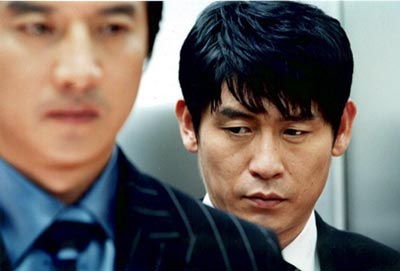
The plot of APE is your standard cop saga fare as Chung Jul Kang, a public prosecutor, tries to take down the corrupt and morally bankrupt Sang Woo-Han, a local golden boy businessman who is also Chung Jul Kang's old high school nemesis. As stated above, the film begins brilliantly, with a flashback to Ching Jul Kang and Sang Woo-Han's high school days when a royal rumble of truly biblical proportions breaks out between their high school ands a crosstown rival institution. The violence is completely unhinged and hilarious and delightfully mimicked some of the cartoonish violence found in earlier Hong Kong action films. Once that action is done, we cut to the present day where Chung Jul Kang and his boys at the prosectors office are preparing a bust on a local crime boss. Just like that, another drawn out, wild bit of mayhem is unleashed as their takedown devolves into an all out brawl between local law enforcement (who all seem to wear leather jackets and jeans to work) and local criminals (who also wear leather jackets and jeans to work).

These few minutes of action alone are worth the price of a rental, trust me. Once they are through, however, not much of interest is left in APA. Indeed, the energy of the film's promising debut is quickly sapped and replaced by a plodding, Law and Order-esque storyline that is shockingly devoid of both action and intrigue. The characters are well fleshed out and the acting is solid but the film's denouement is a foregone conclusion and just getting there is laborious and yawn worthy, criticisms that should really sound the death knell of any self respecting action flick.

Saturday, July 19, 2008

REC


A-

Directed by Jaume Belaguero

One of the nice things about Fantasia, in my opinion at least, is that most of the films on display have not done the major film festival circuit or been relased to a wide enough audience worldwide for any type of critical consensus or "buzz" to be available about them yet. As such, there is often no real way of knowing for sure if the film you are about to watch is going to blow your socks off or be a total stinker. Not so with "REC," probably one of the most anticipated films to ever be shown at Fantasia, having already been lauded by critics worldwide and won a number of Goya Awards, the Spanish equivalent oft he Oscars.

The buzz is well deserved. "REC" is one of the most frightening, tense, and visceral film experiences you will likely ever experience, as it uses every single frame to craft an almost pitch perfect horror film that stands up against anything in the genre I have watched in a long, long time.

"REC" begins in a Barcelona fire department where local TV personality Angela and her cameraman Paulo are working on a segment unoriginally entitled "While you were Asleep" which will focus on oncovering the nocturnal activities of firemen. Their undeniably boring feature is mercilessly spiced up when the fir department receives a call from a nearby apartment building where tenants claim that an elderly lady is stuck in her apartment. Angela and Paulo tag along, hoping to infuse their feature with some much needed excitement. Once they arrive, however, the supposedly routine intervention turns into an emergency when the elderly lady visciously attacks a police officer. Hoping to get the badly injured officer some vital medical help, the firemen are shocked to find out that the apartment building has been sealed from the outside by the health authorities and no one is allowed to leave the premises.

Working on roughly the same premise as "28 Days Later," "REC" takes the terror to a whole new level by locking everyone up in a cramped apartment building and letting the nightmare unfold. The film, at a very paltry 75 minutes running time, doesn't even worry about character development or any type of backstory, choosing rather to thow us right into the fray while the terror escalates. The brevity of the film is actually beneficial as the lack of unecessary dialogue or character develoment allows the film to progress at a torid pace, the scares coming at an almost merciless clip. Easily one of the scariest and most masterfully concocted horror films I've ever watched, "REC" is not recommended for those with weak hearts as this one may very well send you to an early death.

Handle me with Care


B+

Directed by Kongdej Jaturunrutasamee

Kongdej Jaturunrutasamee's "Handle me with Care" is the story of a boy named Kwan who had the poor fortune of beeing born with three arms. Although his extra limb can come in useful in some cases, such as for sorting letters or playing volleyball, Kwan ultimaterly tires of his third arm due to the incessant and negative attention it brings to him from the townspeople. Feeling that it is finally time for him to part with his surplus appendage, Kwan takes off for Bangkok to undergo a potentially deadly procedure that will free him, once and for all, from his cumbersome burden. On his way to beautiful Bangkok (yeah right!) he comes accross the beautiful Na who he saves from an attempted roadside rape. Na feels Kwan's pain because she too is the recipient of unwelcome stares and leering due to her ample bosom. This part of the plot flummoxed me for two reaons, however, firstly because having large breasts is not nearly in the same league as having a third arm and secondly because Na's cans, although undeniably pleasing, were not disproportionately large. Did this make me sound like a perv? Hopefully not because it's a major plot point and I was just trying to uh...clarify some inconsistencies...

Anyways, back to the film. "Handle me with Care" could have easily turned into a film such as the recently released "Penelope" where we all learn that what is on the inside counts and were beautiful no matter what, blah, blah, blah. Although the morale of "Handle me with Care" indeed is that almost everyone has something about their appearance they don't like and that feelings of physical inadequacy are quasi-universla, Jaturunrutasamee does a good job of nuancing this ultimately valuable life lesson with a healthy dose of sympathy and understanding for Kwan's predicament. Kwan never has an "Ah-ha!' moment where he learns that his third arm is a part of who is and those around him must learn to accept him for who he is. Rather, Jaturunrutasamee takes a much more realistic approach towards Kwan's predicament by reminding us that Kwan will never be normal as long as he has three arms but then by suggesting that maybe being normal isn't all it's cracked up to be anyways. Jaturunrutasamee's handling of what is at first ludicrious subject matter is so restrained that "Handle me with Care" turns into a sort of quiet meditation on identity and self worth that succeeds in truly conveyong the emotional state of both Kwan and Na as they struggle with their own feelings of inadequacy, revealing emotional depth that is almost completely foreign to romantic comedies.

Highly recommended for date night.

Thursday, July 17, 2008

The Detective


B-

Directed by Oxide Pang

The Pang Brothers (Oxide and Danny) have had a career trajectory that reminds me somewhat of M. Night Shyamalan's. After making a number of heralded indie releases in their naitve Thailand, the brothers first internationally released film, "The Eye," garnered them considerable global acclaim. Since then, however, the Pang brothers have failed to release anything that comes close to matching "The Eye," just like Shyamalan has never duplicated the success of "The Sixth Sense." The biggest difference between the Pang Brothers and Shyamalan, however, is that Danny and Oxide Pang's releases since "The Eye" have only been guilty of mediocrity whereas everything Shyamalan has made since the "Sixth Sense" has been awful.

Which brings us the "The Detective," the newest release by the Pang Brothers, although this feature was directed by Oxide alone without the help of Danny. The film' s plot revolves around Tam, a Bangkok P.I. who, while trying to track down a woman who allegedly wants to kill one of his bar buddies, stumbles accross a string of grisly murders. As Tam continues his investigation the bodies keep piling up and he begins to think that maybe all the carnage is somehow related and is pointing him towards something more sinister than he may have originally suspected. Mwahahaha!!!

This is, in some ways, a return to form for at least one of the Pang brothers since, as a reviewer for lovehkfilm put it, "The Detective" actually fulfills some of its obvious potential, a feat that the Pang Brothers post-"Eye" films never managed to do. Indeed, "The Detective," although quite pedestrian as far as detective flicks go, is nonetheless intriguing throughout and benefits from the Pang Brothers undeniable flair for eye catching visuals, beautifully capturing the cramped streets of Bangkok's Chinatown. The Bangkok Tourism authority should probably send Oxide a hockey bag full of baht because "The Detective" made Bangkok look way better than the sweaty slab of concrete overrun by sex tourists I recall it being when I visited...

Now that I've grinded my axe, I will say that "The Detective" is a succesfull if not completely riveting or mind blowing take on the detective film.

Wednesday, July 16, 2008

The Rebel


A-

Directed by Charlie Nguyen

Brilliantly paced and choreographed, "The Rebel" is the most pleasant surprise I have had at Fantasia this year and contains some of the most exciting and enjoyable action I have seen put to film since I watched the first three minutes of "Another Public Enemy" last night.

The film centers around Le Van Cuong, a foreign educated Vietnamese public servant who, while minding his own business one fine Saigon afternoon, gets stuck in the middle of a hit orchestrated by a peasant rebel group on a french public official of some sort who, judging by his white on white suit and shirt combo, was probably in Saigon to open up a new KFC. Badam-PISH!
Did I mention the action takes place in Colonial Vietnam during French rule? Because it does.

Although the french official targeted by the hit tragically takes one to the gut, Le Van Cuong and his evil colleague Sy manage to capture the beautiful Vo Than Thuy, daughter of the rebellion's leader and general eye candy. Sy tortures Vo Than Tuy for awhile until Le Van Cuong starts thinking with his groin rather than his brain and helps her escape. They eventually escape Saigon and hit the (dirt) highway together for a road trip of romance and complex fight sequences. Unfortunately for them they are tailed by Sy who believes that Thuy will lead him to her father's hideaway.

The very generic nature of "The Rebel" is not at all a drawback to the film since the plot is mostly there in order to set up awesome fight scenes which "The Rebel" delivers in spades. For the first forty and last thirty minutes of the film it seems that the movie is one, non-stop fight scene that skips from place to place. In the first half hour of the film, main characters fight in exotic settings such as:

1) A colonial mansion

2) A forced labor camp

3) An opium den

4) The harbor front

5) A Saigon jail

And that's just in the first thirty minutes! Charlie Nguyen obviously knows what the audience is there to see and does a commendable job of delivering it in bountiful proportions. Sure, he tosses in some romance here and there and some added bits of emotional intrigue, but this movie is all about the action and in this respect the film is basically flawless as the extremely well choreographed, riveting fight scenes follow each other at a blistering clip. "The Rebel" is 90 minutes of cinematic steroids and I truly pity the fool who doesn't feel like getting an injection.