Friday, January 30, 2009

The Death of Mr. Lazarescu


C


Directed by Cristi Puiu


Critical acclaim is an odd thing. Indeed, critics seldom completely miss the boat on fantastic films and therefore films that often rightfully deserve to be "critically acclaimed" often are. On the other hand, once in awhile critics will convince themselves, each other, and finally the public that films of suspect worth are covered with accolades. If anyone actually thinks this doesn't happen, I give you Paul Haggis's "Crash" and Rob Marshall's "Chicago," both critically acclaimed at the time of their release, both Oscar winners, both horrible films that many of the same critics who once praised them no doubt now wish to distance themselves from as much as possible. So it is, I'd argue, with "The Death of Mr. Lazarescu," directed by Christine Puiu, a sloppily made and clunky critique of Romania's healthcare system that nevertheless succesfully garnered considerable critical acclaim upon its release, even winning "A Certain Regard" at Cannes in 2005.

Mr. Lazarescu, a geriatric widower living in public housing in Bucharest, calls the ambulance one night complaining of head and abdomen pains. While waiting for the ambulance, he shuffles over to his neighbors flat where he is given some encouragement and a measure of medical advice while he waits for the ambulance to arrive which, of course, takes forever. When Mr. Lazarescu is finally whisked away by ambulance, it is only the beginning of a long, painful journey that will take him from one Bucharest hospital to another, passing through the hands of countless medical practicioners on the way, some of whom are concerned for Mr. Lazarescu but most of whom could care less about the old man's quickly deteriorating health.

Cristi Puiu's indictment of Romania's healthcare system, although meant to shock, was far from revelatory in my case for two reasons. Indeed, I was once friends with Romanian professor in university who often regaled me with tales of Romania's broken healthcare system, how women giving birth had to pay for the medical equipment, down to the sponges and towels, needed for delivery or how ambulances could take hours to pick up a patient or sometimes not arrive at all. Puiu indictment of the healthcare system, although not shocking, is therefore far from false or sensationalized and Mr. Lazarescu's ordeal seems to be par for the course in Romania and, from what I've gathered, much of the rest of Eastern Europe. Nevertheless, simply making a film that criticizes a system that everyone already agrees is broken does not, in itself, warrant any praise. It almost seems that Puiu thought that a simple skewering of the medical system without any attention to editing, narrative structure or plot would be good enough to get her film into myriad film festivals which, unsurprisingly, it did. Despite this, the quality of Mr. Lazarescu as a film is horribly low and I can't at all understand how so many critics were ready to simply give its glaring shortfalls a pass since the subject matter being roasted seemed socially appropriate.

"Mr. Lazarescu's" biggest fault is its almost criminal lack of editing. I'm sure some will immediately scoff at that criticism by stating that the length of the movie is a device used by the director to highlight Mr. Lazarescu's long, drawn out ordeal. Fine. If that's the case, make the two and a half hours you're asking audiences to invest in your movie worthwhile. The scenes in "Mr. Lazarescu" carry on ad nauseum and, worst of all, long after their point has been made. Mr. Lazarescu's medical issues are being subordinated to power plays between the medical staff? I got it after the first few scenes yet Puiu felt it was important to keep reminding me that Mr. Lazarescu's health was being given second billing to petty fights by making sure that another one erupted every five minutes. The complete disregard for editing in "Mr. Lazarescu" reminded me of "Crimson Gold," a Jafer Panahi film that was equally unswerving in its belief that the audience would only latch on the its social critique if they were given several hours of tedium to reflect on it.
I really don't think I can chalk up my dislike of "Mr. Lazarescu" to simply "not getting it" either. Indeed, the skewering of the slowness of the health care system as well as the subtle jabs at the carelessness and egocentric nature of those around Mr. Lazarescu in particular and human beings in general was pretty much crystal clear. Puiu's observations are sometimes funny and somewhat perceptive but are never what I'd qualify as groundbreaking stuff. I found it hardly a revelation to learn that the health care system of a notoriously corrupt ex-communist state still in the midst of a painful socio-economic development is slow, innefficient, and buckling under the weight of bureaucry. As a Canadian, my own healthcare system is crippled by innefficiency, long wait times, and underfunding, yet it's still lightyears ahead of most systems found in Eastern Europe so "Mr. Lazarescu" wasn't exactly an eye opening experience. Furthermore, some of the symbolism Puiu uses seemed amateurish at best such as Mr. Lazarescu's rather loaded name which I'm guessing is a nod to the ressurection of Lazarus (Life), Dante descent through the rings of Hell (Mr. Lazarescu's descent through the Hellish Romanian bureaucracy) and finally Remus' death at the hands of Romulus, his brother (Mr. Lzarescu's death at the hands of his countrymen) Uhh...call me a snob but I'm unimpressed.

Eastern Promises


B+

Directed by David Cronenberg

Although I was never a fan of most David Cronenberg's best known works such as "Dead Ringers" and "Videodrome" and found some of his later offerings, films like "Existenz" and "Crash," to be absolutely putrid, he certainly seems to be churning out better products lately, first with the release of "A History of Violence" and then with "Eastern Promises," both films that I thought showcased some of Cronenberg's best talents while doing away with some of his more expendable directorial impulses. "Eastern Promises" in particular is, in my opinion, a fairly resounding success in terms of marrying blunt, sometimes uncompromising violence with compulsively watchable suspense.

Cronenberg's newfound male lead, none other than Habs superfan Viggo Mortensen, stars as Nikolai, a driver to a ruthless Russian mob boss who has relocated to London (it's not clear why but it appears he's having trouble with the Russian police. I didn't even know that was possible!) Business as usual is interrupted for his employer when a midwife named Anna Khitrova (Naomi Watts) discovers a Russian language diary on the body of Tatiana, a 14 year old girl who dies in childbirth, which makes reference to her dreadful handling at the hands of Symeon and other members of their criminal organization. Symeon, realizing that the jig is likely up if the young girl's diary is successfully translated, attempts to destroy the diary and silence those who have read it, enlisting the help of Nikolai in the process. Nikolai, however, goes through a crisis of conscience as he realizes the extent of Symeon's moral decrepitude.

"Eastern Promises" in its mood is somewhat similar to "A History of Violence," mixing slow burning suspense with short bursts of savage violence. Like "A History of Violence," "Eastern Promises" also deals with the moral bankruptcy of the criminal underworld although in this case the criminal underworld Cronenberg depicts retains a measure of classical charm. Indeed, Symeon's headquarters, a resatuant called the Trans Siberian, is a lavisly decorated, classically refined eatery in the middle of London, filled with reach looking people eating rich looking food. Cronenberg, however, masterfully constrast the superficial pomp of Symeon's lair with his place of business, a rundown brothel on the outskirts of town, filled with his drug addled and abused merchandise. Cronenberg's portrayal of the criminal organization as a nexus of decay rather than as an institution of social significance with honorable ends to its sometimes dishonorable means is Scorcese-esque in some ways and is brilliantly underpinned by his protrayal of Symeon, a man who pays lip service to the importance of family only to later offer up his own son for sacrifice to a rival gang.
Cronenberg's fascination, however, is not simply with the moral erosion of individual's engaged in such crime but with the psychological effect of violence and criminality on them. Since "A History of Violence," Cronenberg has appeared to be most interested in the long term effects of crime and violence on individuals, a theme he returns to in "Eastern Promises."

The denouement of the film was a bit disappointing simply because the film had until that point been following a hyper realistic and unvarnished premise and suddenly veered into a somewhat maudlin, even corny, conclusion. Nevertheless, there is too much good in this film, from the solid acting by Mortensen and Watts to Cronenberg's tight direction, to really spend any serious time nitpicking its few faults.

Sunday, January 25, 2009

The Prestige


B-

Directed by Christopher Nolan

I'll admit that when "The Prestige" came out a few years back I constantly mixed it up with the "Illusionist" and thought the two films were one and the same or contained various actors from the other film. As such, I was shocked to find out that "The Prestige" did not star Edward Norton but in fact Christian Bale who, of course, I had previously believed was the star of "The Illusionist." Since watching and reviewing films is only a hobby of mine I feel that this type of amateurishness can be excused.
In any case, when I found out that "The Prestige" not only starred Christian Bale but was also directed by Chris Nolan I was excited to give it a look, having fairly unwavering faith in Nolan's ability to deliver a film that if not completely jaw dropping would at least be entertaining. Although "The Prestige" did, in its own way, turn out to be rather entertaining it was also crippled by a script so ridiculously implausible that it required a such a complete suspension of belief that is essentially prevented any actual engagement on my part.

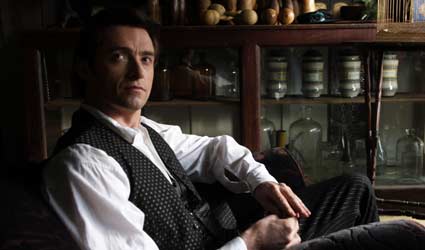
"The Prestige" stars Bale as Alfred Borden and Hugh Jackman as Robert Angier, both turn of the century magicians plying their trade in dirty, lawless London. The two magicians originally work together as members of a the same magic troupe before the death of Angier's wife, also a member of the act, forces a rift between the two as Angier blames Borden for her death. The relationship sours further as both magicians begin their solo careers, attempting to both one up each other and sabotage the other's act, leading to an obsessive, arms race like escalation of sabotage and treachery eventually leading to Borden's murder of Angier, shown at the very beginning of the film. This death, however, as well as Borden's responsibility for the murder, is unsurprisingly not what it first appears to be, leading to a denouement full of double crossing, intrigue, and bombshell revelations.

"The Prestige" is based on Christopher Priest's 1995 novel of the same name and, like Priest's novel, is epistolary in nature, based on the two magician's diaries and jumping back and forth through time, like many of Nolan's previous films. The narrative structure is not necessarily at fault here, nor is the acting, cinematography, or editing of the film, all of which are superb. The problem with "Prestige" is simply that, like its main characters, it tries so hard to dazzle its audience that it eventually appears to bend and break under the weight of its bloated, unbelievable narrative. I have no problem with suspending belief in order to enjoy a film and in most cases such suspension of credibility is necessary for films to succeed. In the case of the "Prestige," however, Nolan and company really do go to far, concocting a story with so many truly unbelievable twists and turns that the end result is a sometimes entertaining but mostly ridiculous story that simply defies belief. Nolan is, of course, a supremely talented director who has directed highly successful and very well made films on a variety of budgets, but his talent here is unfortunately wasted. I suppose it could be argued, however, that without Nolan's direction and without the strong efforts of Christian Bale and Hugh Jackman as the rival magicians "The Prestige" could have been far worse. As it stands, however, "The Prestige" resorts to gimmicks of truly odious proportions to entertain it's viewers which was is not only unnecessary considering the pedigree and talent of the the film's cast and crew but is also rather disappointing since Nolan is a director I expect a bit more restraint out of when it comes to storytelling.

30 Days of Night


D

Directed by David Slade

"Hollywood adaption" are two words that often inspire fear/agony/pain in the minds, bodies, and souls of most film lovers but Hollywood has recently been succesful (albeit in highly varying measures) in its effort to adapt graphic novels to the big screen. Indeed, from "Sin City" to "A History of Violence," Hollywood has pumped out some smashing, and rather surprising, adaptions of graphic novels in recent years. Of course, for every "Sin City" there have been a few "Elektra's" and for every adaption of "A History of Violence" there have been equal measures of "Daredevil" and "Josie and the Pussycats." So when I heard that Stephen Niles and Ben Templesmith's horror miniseries "30 Days of Night" had been turned into a big budget Hollywood production, I held out hope fo something awesome but remained open to the possibilityn that it would suck. Unfortunately for me, it was more of the latter than the former, as Slade's version is a rather convoluted and lazily acted/edited/directed version of the source material.

The film opens as the residents of tiny Barrow, Alaska prepare for the oncoming month long darkness that will envelop their small town. Most of the population takes off towards sunnier destinations while the remaining residents, including local hunky sherriff Eben (Josh Hartnett). As night falls, however, things start getting weird. The power to the town is cut, as are the phonelines, and a pack of huskies is violently killed on the outskirts of town. It isn't long before the residents of Barrow realize they may be accomodating a number of unwanted visitors over the course of the month, namely a pack of ravenous, blood thirsty VAMPIRES!!! After an initial slaughter of the villagers, a number of survivors succeed in banding together and taking refuge in an abandoned attic, faced with the prospect of fending off the murderous advances of the vampires for an entire month before the sun returns.

"30 Days of Night" is a slick and glossy Hollywood production that, frankly, looks great. People like myself whine and moan about American films but one thing I must often admit is that no matter how crappy the film, most Hollywood productions, due mainly to their oftentimes ridiculously bloated budgest, serve as shameless eye candy. Beyond the sleek looks of the film, however, "30 Days of Night" doesn't have that much else going for it. Indeed, as a reinvigoration of the vampire genre, the film is woefully lacking, as it attempts to pump some blood (har, har) into the genre by featuring vampires who run really fast and are seemingly more intelligent than their more glassy eyed, intellectually vacant predecessors. Ultimately, however, the vampires in "30 Days of Night" appear neither scary nor that dangerous, as they are often defeated with a single blow from a blunt object.
The film's major downfall, however, is not its rather uninspiring villains or even its refusal to develop any significant human intrigue between the town's survivors but rather its absolutely remarkable laziness in ironing out any narrative inconsistencies or plot holes. Indeed, the film is marred by several glaring lapses in realism that are too numerous and egregious to simply toss into the "no story is perfect" pile. Several times during the course of the film, for instance, a character, usually Josh Harnett's, will inform the survivors that they must move to another building for some reason, oftentimes poorly explained in the film. The character then proceeds to make his way from Building A to Building B solo at which point he is pursued relentlessly by the vampires and only barely makes it to Building B safely, only to find that the rag tag band of survivors is already there waiting for him, having obviously done the trek with far less strain or inconvenience than he did. This is only one of the many head scratching moments in a film filled with them.
"30 Days of Night" wasn't completely unpleasant like some other recent entries in the American Horror genre have been (i.e. the "Hostel" and Saw" series) but it was pretty boring, a sin that is onforgiveable for a film that is meant to be enjoyed with as little intellectual engagement as possible.

Sunday, January 18, 2009

Righteous Kill


D-

Directed by John Avnet

Both Al Pacino and Robert Deniro's once brilliant careers have admittedly lost some of their luster in the past decade with a number of appearances in mediocre to bad films. Neither have starred in a good film since the end of the 1990's and their recent acting choices have been mystifying to say the least. Their decision to appear together in John Avnet's "Righteous Kill" continues their paths of artistic self destruction, although this time they got to star in a stinker together.

Pacino and Deniro star as two buddy cops from New York who pretty much fit the mold of stereotypical goombah New York City cop that has been retread in hundreds of crappy cop flics before this one. It turns out, however, that Turk "Robert Deniro) has been doing some extra duty as a vigilante, waxing local criminals who may have escaped the long arm of the law. As his crime spree continues, however, a number of his colleagues grow suspicion and the heat rises, forcing Turk out into the open and revealing the true depths of his treachery. Pacino ends up involved in some capacity but his role is mostly reduced to shouting profanities at criminals and screaming "OHHHHHHH" loudly at odd intervals which is, I imagine, supposed to give him a vibe of danger unpredictability.

The game plan here seems to have been to recruit Deniro and Pacino, give them a number of "cool" one liners and let them crap out a diamond of a movie. Unfortunately, you can't expect actors, no matter how talented or cherished they may be, to simply carry your lame film for you. "Righteous Kill" certainly isn't helped by the fact that Pacino and Deniro, who appear to have been tasked with the success of the film, deliver uninspired performances and look like they are both there to simply collect a paycheck, which they probably are. The plot is lazy and formulaic and the third act is both predictable and implausible which makes it that much worse since you're basically anticipating that the story will attempt to feed you an unlikely ending, which it does. Ultimately, "Righteous Kill" was doomed from the start by a horrendous script and it could only get worse or marginally better from there. I'd argue that the involvement of Pacino and Deniro probably made it worse because their presence alone raises expectations that sparks may fly and something memorable might endup on the screen. Not so, unfortunately.

Saturday, January 17, 2009

Picnic at Hanging Rock


A-

Directed by Peter Weir


"Picnic at Hanging Rock" was the film that not only helped launch Peter Weir's film career but was also critical in putting Australian cinema on the global map. It remains Weir's best known work and a classic film whose open ended conclusion still sparks vigororous debate to this day.

Weir's film is set in a girl's preparatory school in the sunblasted Australian outback at the turn of the century. Ms. Appleyard, the school's headmistress, organizes a picnic for her students at Hanging Rock, a volcanic rock formation that sits on the edge of town. Things at the picnic go bad, however, when three girls, along with one of the school's teachers, disappear on the rock leaving little trace of their whereabouts. Their dissapearance sparks a widescale manhunt lead by the town's understaffed police department as well as a number of individual search and rescue attempts, most notably by a young aristrocrat who may have been the last person to see the girls alive on the rock. As the days wear on and the search intensifies, a number of strange occurences are reported by those who have visited to the rock in search of the girls.

The film's conclusion is notoriously open ended and has given rise to a multitude of explanations as to the girls' ultimate fate. The ultimate resolution of the film is debatable but a quick cruise through the internet reveals that those who have read Lindsay's novel, including an extra chapter published after her death that more or less confirms the girls' fate, are fairly confident in an ironclad resolution to the film.
Resolving the missing girls' fate largely overshadows the other merits of "Picnic at Hanging Rock" which is too bad since Weir's film isn't just a slipshod adaptation of Lindsay's novel but rather an atmospheric and haunting interpretation of a literary work that was likely quite difficult to translate to the screen. I feel that seeking a "resolution," although appealing, is largely detrimental when watching this type of film simply because the point isn't to be mesmerized by twists and turns but rather to be enveloped by the mood of the film. As such, it's a film that demands repeated viewings, not just to pick up "clues" as to the girls whereabouts but also to enjoy the finely crafted experience Weir and his talented cast created.

Sunday, January 11, 2009

A Clockwork Orange


B-

Directed by Stanley Kubrick


Stanley Kubirck's classic adaption of Anthony Burgess's novel evolved from a divisive, controversy baiting shock piece that was banned in the UK, censored in the United States that was reviled by a number of notably film critics, to a work that has largely been accepted into the pantheon of "great films" of the 20th century. Although I can certainly understand the praise, "A Clockwork Orange" being a brilliant achievement from a technical standpoint, it remains in my opinion a dark, unpleasant work that largely brushes aside issues of personal responsibility for violent or criminal action in an effort to pontificate on the ill effects of authoritarian government.

Alex, a young punk who commandeers his own band of thugs--or "droogs", as they are called--spends his days sleeping and his nights cruising around a neo-Fascist London engaging in, as he famously calls it, the "old ultra-violence" robbing, raping, beating and looting. Alex's life of crime is derailed, however, when an attempted burglary goes bad and he ends up bludgeoning a middle aged woman to death before being nabbed by the local bobbies. After appearing in court and pathetically claiming his innocence, Alex is sentenced to a hefty jail sentence at the local penitentiary. Wanting a quick out, however, Alex devises a plan to get out of prison far sooner than expected by participating in the government's new prisoner rehabilitation program. As Alex soon finds out, however, the price of a quick trip out of jail is possibly more than he had bargained for.

Kubrick's interpretation of Burgess's classic novel is, from a technical standpoint, virtually flawless. The vibrancy of the film's images, the crisp editing and creative shooting was so far ahead of its time that watching "A Clockwork Orange" next to other film's produced around the same time is almost shocking. Burgess's novel was definately original in many ways but credit needs to go to Kubirck for adapting it in such a eye catching and sleak way. Despite the technical brio of "A Clockwork Orange," however, I must say that it remains one of the most vapid social commentaries I've ever been exposed to and a generally unpleasant, ugly film. The massive protest and controvery that accompanied the film's release gave the public the illusion that there was some pretty heavy stuff going on in "A Clockwork Orange" and this misconception has continued to this day, leading Kubirck's film to be legitimized as a serious critique of right wing authoritarinism as a cure for a lawless society. In reality, "A Clockwork Orange" has little perceptive to say about issues such as the rehabilitation of criminals, the usefulness of prisons, or the nefarious effects of autocratic policies on free society. Moreover, as Pauline Keale noted in her review of the film in the New Yorker when it was originally released, "A Clockwork Orange" is almost pornographic in its efforts to dehumanize Alex's victims while in the end attempting to curry sympathy for his abuse at the hands of the government. Call me callous, but in the end I felt little sympathy for Alex, whose jail sentence and subsequent pyshcological trauma following his "rehabilitation" seemed quite well deserved, nor did I feel that anything significant was said about Alex's treatment at the hands of the government. It doesn't help that "A Clockwork Orange" takes itself deadlyt seriously and almost smacks the viewer in the face with its claims to high art. Nevertheless, the technical brilliance of this film makes it impossible me to simply turn up my nose at it no matter how much I may have disliked the film's content.

Wednesday, January 7, 2009

The Godfather, The Godfather II


The Godfather


A+


The Godfather II


A

Directed by Francis Ford Coppola


The "Godfather" and "The Godfather II," as Roger Ebert points out in his review for the two films in his volume "Great Films," are part of a very select canon of films that seemingly every American has seen at least once. Indeed, the first time I saw the "Godfather" I was around 15 years old and felt like a complete Philistine since everyone else I knew had already seen it, in many cases multiple times. The transition of Francis Ford Coppola's mob movies from simply great films to essential elements of American artistic heritage is certainly attributable in many ways to its titillating subject matter, the mob having always been a rather guilty obsession of many Americans, but the lasting importance of both films in the annals of American film is a testament to the brilliance of each work which, together, form one of the most important achievements in American film history.

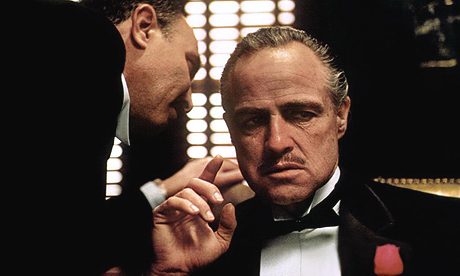
"The Godfather" trilogy follows the Corleone family, from the arrival of patriarch Don Vito on Ellis Island at the turn of the century to the death of his son Michael decades later, as they build a criminal empire in America. "The Godfather" follows the rise of Michael Corleone (Al Pacino) as he returns from the war and is slowly sucked in to his fathers business, eventually taking the reins upon his father's death. "The Godfather II" features two separate story lines, one following Don Vito's arrival and early days in America, and the other focusing on Michael who is now focused on legitimizing his late father's business by investing in viable, legal enterprises around the globe.

The above synopsis obviously does the two films little justice as both are densely layered pictures with multiple story lines and elements of of intrigue running through them and the vastness of both films contribute in making them the staggering achievements that they are recognized as being today. Both films are also recognized as being equally brilliant which is no small feat considering the legendary difficulty of following up critically acclaimed films with equally succesful sequels. Indeed, "The GodfatherII" is often cited as an example of a sequel that is better than the film it follows. Although I tend to disagree, my preference for the first "Godfather" is more a question of taste than any real difference in excellence between the two films. Indeed, the two first chapters of the "Godfather" trilogy represent together one of the towering achievements in movie history, films that are both grandiose and gripping, complex and thrilling.

One major difference between "The Godfather" and "The Godfather II," I would contend, is that the former film was a veritable all star game of acting, featuring performances from a who's who of American screen greats, from Pacino to Brando to Duval to Cazale. Although Deniro only shows up in the second film and his performance is obviously fantastic, the interplay between a cast of great actors that really buoys "The Godfather" is noticeably absent from "The Godfather II." I've also aways felt that the back and forth narrative of the second "Godfather" robs it of some of the same intrigue and depth that is apparent in the first "Godfather" where the story is sungularly focuses on the present day. Regardless, these are, as I already pointed out, mostly questions of taste. Both films are fantastic, both films are classics, and both films are probably available somewhere on VHS for $4.99.

Saturday, January 3, 2009

Lemming

B+

Directed by Dominik Moll

Dominik Moll has the potential to be France's next Henri Georges Clouzot, a.k.a France's next Alfred Hitcock. His ability to build suspense out of seemingly yawn inspiring domestic situations is exciting and refreshing and a harbinger of an immense talent that will eventually produce something special if he doesn't stray from the path. Although "Lemming," his second major effort, isn't quite as good as his first "With a Friend Like Harry," it remains a rather firm affirmation that Moll is a talent to be reckoned with.

Alain and his wife Benedicte (played here by my cinema crush Charlotte Gainsbourg) lead a seemingly perfect life--Alain is an up and coming engineer at a local firm and Benedicte is a busy housewife--until their marital bliss is interrupted by a visit from Alain's boss and his excentric spouse Alice (an unbelievably spooky Charlotte Rampling). Things start to go awry after their unfortunate visit and Alice begins to intrude in Alain and Benedicte's wife until one day she inexplicably commits suicide after an unannounced visit to their home. Thing only get weirder afterwards as Benedicte becomes increasingly aloof and Alain fears losing her to his lecherous boss.

Moll has firmly established himself as the king of domestic suspense. His previous film "With a Friend Like Harry," was a fantastic psychological thriller that was both plausible and gripping, guided by tight direction from Moll and buttressed by supremely talented actors. Moll's ability to build suspenseful narratives out of seemingly mundane events without having recourse to elaborate dream sequences or supernatural explanations is refreshing in a genre where many filmmakers just can't seem to keep the tension going without having to resort to a crazy, often barely plausible third act or some other type of shenanigan to make everything fit. In this respect, "Lemming" can be considered something of a failure since Moll builds up the tension to a point where he cant deliver a denouement that both satisfies the viewer and jives with reality. he therefore ends up having to throw in a certain amount of supernatural happenings into the mix to make everything "fit." That's too bad, mainly because he found a way to keep the tension high without having to cop out in his previous film "With a Friend Like Harry" which is why I consider "Harry" a more complete success than "Lemming."
Regardless of how plausible the story is and the undoubtedly sloppy third act, Moll has an unmatched ability to create creepy, atmospheric pieces out of everyday situations that appear (mostly) believable and are reminiscent, dare I even say it, of some of Hitchcock's spookier pieces.

Thursday, December 25, 2008

When a Woman Ascends the Stairs

A

Directed by Mikio Naruse


"When a Woman Ascends the Stairs," arguably the masterwork of Mikio Naruse, the "Fourth Master" of Japanese cinema, displays the work of a director who, like his co-masters, Kurosawa, Ozu, and Mizoguchi, operated on a 'cinematic plane," so to speak, that few directors can even aspire to, let alone reach. Although it may sound hyperbolic, when you sit down and watch the best work of these four directors (and "When a Woman Ascends the Stairs" definitely stands up to the best of Kurosawa, Ozu, or Mizoguchi) you can't help but be humbled by their work. There's a timelessness and understanding of the human condition that infuses much of the best work of these four directors and explains why all four are so revered amongst both filmmakers and film watchers.

"When a Woman Ascends the Stairs" is, in many ways, one of Naruse's most biting social critiques. It follows the efforts of "Mama" (played by Hideko Takamine), a bar girl in Tokyo's Ginza district who wants, like most of the girls around her, to find a way out of the crummy confines of the bar that employs her and begin enjoying a measure of personal freedom. As Naruse is careful to point out, however, post-war Japan was no place for a woman's dreams to find flight and indeed Mama, although headstrong and intelligent, finds her efforts at securing a better future for herself and her extended family thwarted at every turn. Naruse's empathy for the plight of women gives "When a Woman Ascends the Stairs" an almost feminist perspective, as Mama's inability to find happiness is shown as a direct by product of a strictly male dominated, patriarchal society.

Since "When a Woman Ascends the Stairs" is widely considered the penultimate achievement of one of Japan's greatest directors, it should be unsurprising to hear that there isn't much to criticize here. Indeed, Naruse's film is anchored by wonderful dialogue, a cool aesthetic, and great performances from its leads, particularly the wonderful Hideko Takamine as Mama. Naruse is often compared to Ozu, not so much for his material (Naruse was interested mostly with members of lower social strata than Ozu who studied mostly middle and upper middle classes families), but due to their similar ability to tell rather minimalist stories that nonetheless have a profound emotional resonance and are both very "Japanese" and timelessly universal as well. Nevertheless, I have always found that even though both directors' best work is indeed perceptive about human interactions and emotions, to a degree almost unmatched by any of their peers, Naruse never really hit the level of universal "transcendence" (for lack of any better word) that Ozu did. Indeed, in "When a Woman Ascends the Stairs," I felt that Naruse's point was perfectly summed up in the brief paragraph on the back of the Criterion Collections edition of the film, which noted how in the film "Keiko (Mama) comes to embody the struggles of a woman trapped in a male dominated world." Indeed, this is mostly the crux of the story in "When a Woman Ascends the Stairs." Mama tries to make a place for herself in a patriarchal society but finds herself increasingly frustrated by the very fact that she lives in a male dominated society. As such, Naruse's point seems to be that it was tough to be a woman in Japan in the 1950's. So I've heard.
Beyond that, however, and despite the fact that this point is well illustrated throughout the film, this seems to be the extent of the work. I'm sure Naruse scholars would scream bloody murder if they read this, but I can't help feeling that there just isn't as much simmering beneath the surface of "When a Woman Ascends the Stairs" as many believe there is. This "criticism," however, is actually anything but and is rather a question of a personal taste moreso than any shortcoming in Naruse's film. Indeed, "When a Woman Ascends the Stairs," is a deep, moving, and flawlessly executed film and the only real elements to nitpick or argue over come down largely to questions of preference.

Tuesday, December 23, 2008

Shaolin Soccer


B+

Directed by Stephen Chow

Although "Kung Fu Hustle" remains my favorite Stephen Chow film, the similar "Shaolin Soccer" is often equally hilarious and visually engaging, showing of Chow's aesthetic panache and flair for a physical, slapstick brand of humour that is mixes well with his subject matter.

Stephen Chow pulls double duty in "Shaolin Soccer," both serving as the director and the star of his film, in this case playing a downtrodden, jobless Kung Fu master named "Mighty Steel Leg" Sing whose skills have been rendered useless by the population's waning interest in his art. As a way to stave of bankruptcy he plots to enter a local soccer tournament and vie for the million dollar prize. To do so, he attempts to enlist the help of his brothers, all of whom are also former martial arts masters now struggling just to get by. After some initial reticence, the brothers finally agree to join Mighty Steel Leg and participate in the tournament. Hilarity obviously ensues.

Chow did well to cast himself as the lead in "Shaolin Soccer." His comedic timing is second to none and he infuses the whole film with a sense of non stop raucousness that is a pleasure to watch. Much like "Kung Fu Hustle," "Shaolin Soccer" is notable for its CG powered stunts, Chow and his buddies flying through the air, sending soccer balls to the moon, and succeeding in pulling off a variety of other totally implausible kung fu/soccer moves. Chow's heavy reliance on CG gives the film a complete lack of believability but anyone who expected something authentic in a film titled "Shaolin Soccer" deserves to be disappointed. As comedy, "Shaolin Soccer" works susprisingly well and is consistently funny despite the fact that many jokes probably didn't translate well from Mandarin to English.

A great little movie. I recommend it to everyone.

Late Spring


A+

Directed by Yasujiro Ozu


Yasujiro Ozu's, throughout his distinguished career, pumped out masterpieces at an almost assembly line like pace, making 33 films, many of which are towering achievements in their own right. Amongst his career's work, however, three particular films stand out as arguably his best, namely "A Story of Floating Weeds," Tokyo Story" and "Late Spring." Although "Tokyo Story" often gets the nod as Ozu's best film, "Late Spring" is my favorite, mostly because it deals with a much more nuanced and rarely dealt with issue, namely the relationship between a father and daughter, than "Tokyo Story" which examines (albeit masterfully) the generational conflicts experienced by Japanese families in the aftermath of World War II.

"Late Spring" focuses on Noriko (played by longtime Ozu cast member Setsuko Hara), a 27 year old women who still lives with her widowed father, Shukichi (played here by another recurrent Ozu player, Chisu Ryu). Sukichi worries that his daughter should seek a husband, a concern shared by Sukichi's sister who wants desperately for Noriko to wed, fearing she will become something of an old maid if she does not. Noriko, however, appears to be altogether unimpressed with the prospect of marriage and would prefer to continue living the quiet life she enjoys with her father.

Like most of Ozu's great works, "Late Spring" has more to say about big issues such as the relationships between parents and children and the constraints of societal expectations and pressures in a few frames than most films can cover in their entire length. Ozu is praised in almost religious terms by most film critics and scholars and the praise can seem overblown until you watch some of his masterworks and realize that his films more than deserve the semi-religious reverence that is attributed to them. Ozu's ability to tackle major existential issues through anecdotal situations is perfectly illustrated in "Late Spring" where the focus revolves primarily around the day to day life of Noriko and her father and the details of the tension between them, as well as their own hopes and aspirations both for themselves and each other, most of which is communicated non verbally until the end of the film when Noriko finally and bluntly lets her father know her wishes, resulting in a rather unvarnished show of emotion that stands in stark contrast to the restrained exchanges between father and daughter that proceeded it. The final impact is, in many ways, devastating, as Noriko attempts to keep her perma-smile plastered to her face even as she fights back tears, asking her father why things can't simply remain the way they are. It remains one of the better scenes in movie history (I know this appears to be a hyperbolic statement, but I don't consider it very controversial) and showcases Ozu's ability to deliver emotional power to his stories without having to resort to stirring strings, slow motion scenes, or other similar devices. No, like most of Ozu's films, "Late Spring" is delivered unfettered and bare, it's emotional impact stemming entirely from the fact that as viewers we can relate, in an almost universal manner, to what we are seeing on the screen.
It doesn't hurt, however, that "Late Spring" is anchored by the acting of Setsuko Hara and Chisu Ryu whose performances here are wonderful. I recently watched "Black Narcissus" by Michael Powell and Emeric Pressburger, a film released in 1947 which, although very good in its own right, features mostly the type of acting that I've come to expect from English actors of that era, namely a range of emotions that is strikingly limited, appearing to have two settings; either "utter rapture" or "overwhelming fear." The acting in "Late Spring,'" which was released around the same time, is infinitely more complex, and Hara especially succeeds in conveying Noriko's emotions, both those repressed and those released, with unbelievable authenticity. The rather apparent disconnect between the type of almost caricaturistic acting in a film like "Black Narcissus" and the restrained, and truly lifelike acting in "Late Spring" leaves me puzzled as to where, exactly, Ozu's actors acquired their acting chops and why Western actors have, in many ways, never caught on to the "less is more" realities of conveying human emotions.

Wednesday, December 17, 2008

Black Narcissus


B+

Directed by Emeric Pressburger and Michael Powell

Pressburger and Powell's tale of nuns gone wild in the Himalayas is noted more for its gorgeous cinematography than its plot line, but "Black Narcissus" rendering of the age old battle between the spirit and the flesh contains a number of insightful nuggets into not only the nagging desires of men and the relentless temptations of pleasure but also the importance and place and space in shaping individuals.

Sister Clodagh and four other of her fellow sisters are sent to establish a convent/hostpital/girls school for the inhabitants of a remote village in the Himilayan mountains. When they arrive, they are met by hunky, misbehaved Mr. Dean whose sex appeal is undeniable though I'm not sure how and why he ended up living in such a remote area of the world in the middle of the twentieth century. I guess the Brits have always been an adventurous lot...
Regardless, the sisters are soon faced with a number of difficulties as they all try to keep busy in the windswept, secluded convent while not giving way to their own desires which, isolated from the rest of the civilized world, have slowly crept up on them.

During their time, Powell and Pressburger rolled out masterpieces at an almost predictable clip. Although much of their success can be attributed both to their concern for detail and aesthetic value of their films ("Black Narcissus" and "The Red Shoes" often being the director's two most cited movies mostly for their visual flair) Powell and Pressburger's films also manage to deal with subject matter that is timeless and familiar to most viewers. Indeed, "Black Narcissus" examines perhaps one of the oldest dualities in human history, that between duty and desire and between our basest carnal instincts and what we believe is morally right. The honesty of Powell and Pressburger's investigation of this particular dilemma in "Black Narcissus" is particularly moving since Sister Clodagh and her fellow sisters are never painted as being simple dupes of the faith but rather as true believers whose fervent belief in the righteousness of their religious faith nonetheless belies aching desires for the "things of this world." Likewise, raucous and rude Mr. Dean is never judged for his refusal to believe but rather allowed to explain it. As such, the disconnect between sister Clodagh and Mr.Dean is never as large as it seems, their differences explained only by the energy they are both willing to expend in believing in God's providence and power.

Blow Up


B-

Directed by Michelangelo Antonioni

Did I just give "Blow Up" a "B-"? I sure did. Michelangelo (his ghost, that is) will be PISSED when my reviews hit the big time and he finds out that I refused to fawn over one his most beloved and revered works. Sure...
"Blow Up" is not a bad movie but after hearing only good things about it, especially from critics I hold in great esteem such as Peter Brunette, I though this film was going to be a barnburner, which it unfortunately wasn't. Despite this, however, there is still alot to recommend in "Blow Up" and I can certainly understand why so much ink has been spilled writing about it.

David Hemmings plays a yeah-baby photographer in London in the swingin sixties, racing around town in his Bentley, taking photographs of mostly nude female models, getting laid, and generally fulfilling every stereotype anyone ever had about life in the hip and sexy sixties. His philandering is put on hold midway through "Blow Up" (and let me stress that "midway" is probably generous--the action only gets underway very late in the film) when he helps himself to some photos of Venessa Redgrave and her lover in a park and has them developed only to discover what he believes was a murder taking place at the time he took the photos. But was it really murder, or iws David Hemmings just crazy?

The subjective nature of reality is an issue that has been an alluring topic for directors to tackle since the very dawn of the cinema. It really has blossomed into a genre unto itself and a number of classic films fall into this particular category, films such as Kurosawa's "Rashoman" or Peter Weir's "Picnic at Hanging Rock." Just today I picked up a Korean film titled "A Virgin Stripped Bare by Her Bachelors' which promises me a similar essay on the elusive nature of reality. The appeal of such films is not hard to see, and I would argue that many directors are drawn towards such stories because they offer an opportunity to construct movies that are suspenseful, complex, and, above all else, open ended. Indeed, films like "Blow Up" are maddeningly open ended and it almost seems that directors like Antonioni like it that way because they can simply toss the film out there and let academics and laypeople interpret every which way, eventually giving the film a meaning of its own that may or may not have been intended by the director. Burnett in his commentary even admits that "not everything" adds up in "Blow Up," which is okay, I suppose, but there are obviously limits to how open ended you can make your story. All we ever learn in "Blow Up" is that a murder may or may not have happened and David Hemmings may or may not be imgaining things. The climx of the film, the infamous "mimes playing tennis" scene, simply confirms what we've suspected all along, namely that in "Blow Up," reality consists of what we choose to buy into as opposed to what is really there.
Having to sit through a two hour film to be given such a wishy washy message is a bit annoying, frankly. Nevertheless, the film is suspenseful and stylish enough that you don't just feel ripped off at the end by the rather lackluster payoff. Like most of Antonioni's films, "Blow Up" might not be perfect but from an aesthetic point of view there is enough of interest going on that is is worth a watch regardless of how you feel about the underlying "message" of the film.

Monday, December 15, 2008

Quantum of Solace


B

Directed by Marc Foster

"Quantum of Solace" was in many ways undone by the success of "Casino Royale" insofar as the latter film, a literal bucket of ice water to the face of critics who had grown tired of Pierce Brosnan's limp wristed 007, was both excellent and very well received which set a rather unrealistic standard for "Quantum of Solace" to strive for. Indeed, "Quantum of Solace", although not nearly as good as "Casino Royale" is still a very satisfying action film that is similar in many ways to its predecessor and didn't deserve the lukewarm reception it was given by film critics upon its release.

After Vesper Lynd's betrayal and death, Bond sets out to find her would be assassins and administer some serious street justice. Things go awry when Mr.White lets Bond and M know that he's part of something much bigger than himself, a fact he punctuates by ordering M's longtime body guard, who was obviously and Mr.White's payroll, to break rank and start shooting everyone. TREACHERY!!! The rest of the film follows Bond as he attempts to track down the leaders this global conspiracy and uncover their dastardly designs which, in the case, have an evil eco-twist.

"Casino Royale" rejuvenated the Bond series in the same way as "Batman: The Beginning" brought the Batman series back to life. However, whereas "Batman: The Beginning" was basically just a way to warm up audiences for the jaw dropping spectacle that was "The Dark Night," "Casino Royale" appears to have not only been the jolt that shocked Bond back to life but also the gold standard for the series which "Quantum" simply failed to match. Despite this, "Quantum of Solace" is an immensely enjoable film that delivers actions and international intriguer in spades and in th best spirit of the most memorable Bond films but also highlights Daniel Craig's appeal as a brutal, hard-assed Bond who can not only dish out the pain but take a fair bit of it himself. Indeed, I had long argued (as other had) that the casting of Brosnan had killed the Bond franchise, essentially wussifying 007 and making him into a debonair ladies man that looked like he could barely shoot a gun, let alone win a close quaters knife fight. Craig simply looks like he belongs in these films and his casting as Bond has been a major asset to the film and one of the main catalysts to the series' revival.
Despite all that is good about "Quantum," I will say that the whole thing seemed a bit thin and was noticably less layered than "Casino Royale." I personally blame the script since everything else in this film appeared to be clicking on all cylinders but there just didn't seem to be anywhere for the story to go. In the end, though, this film is far better than it has been given credit for and is a wild and enjoyable ride that is worth watching.