Monday, August 10, 2009

Portrait of a Beauty

A-

Directed by Jeon Yoon So

Jeon Yoon So's highly fictionalized biopic of the very real Joseon era painter Shin Yoon Bok, although flying in the face of historical accuracy, mines the beautiful and regal costumes and customs of the Joseon Dynasty to their maximum effect, the end result being an absorbing and absolutely gorgeous looking period piece.

Yeong Jun, a young girl, is sent to study under Hong do Kim at the the royal court. Since women were not allowed to paint in any official capacity during the Joseon Dynasty, she poses as a young man, painting under the name Shin Yoon Bok. Her ruse is soon discovered by local mirror salesman Kang Mu who she falls deeply in love with. Keeping the charade going proves difficult, however, as the scheming courtesans and artists of the royal court conspire to reveal Shin Yoon Bok's true identity.

When it comes to period dramas, this is how it's done. Jeon Yoon So mixes lush, beautiful images with lurid melodrama in just the right amounts, providing an experience that is mesmerizing to look at but nonetheless buttressed by some narrative substance. In the end, however, it truly is the visual aspect of Jeon Yoon So's film that linger with the viewers after the credit rolls. The attention to recreating the Joeson period details as accurately as possible is commendable but it's the inspired work of the cinemtographer (whose name I still don't know--reveal yourself!) that steals the show, equally impressive in his (or maybe her--the question seems apt considering the subject matter of the film) fluid camerawork and gorgeous framing of long shots takes "Portrait of a Beauty" to ravishing heights. Jeon Yoon So seems to have realized, however, that it is not enough to simply roll out a parade of ornately dressed courtesans and plop them in the middle of windswept field why the orchestra crescendos in the background and there's some first rate artistic direction in "Portrait of a Beauty" that maximize the impact of the film's already considerable attention to detail and beautiful images. The historical accuracy of "Portrait of a Beauty" was hotly debated upon its release with a number of scholars decrying the liberties taken with Shin Yoon Bok's life, who, in all probability, was in fact a man. Although I have a special disdain reserved for films that try to market themselves as historically accurate but in reality are not, "Portrait of a Beauty" is an obvious fictionalization of a story based on a historical "what if." I have trouble seeing how the historical liberties taken with Shin Yoon Bok's life lessen his legacy, especially since Jeon Yoon So's film is unabashed historical fiction.

Although originality in film is great, there's always a measure of satisfaction in seeing something that's been done before be recreated in an especially new and interesting way. "Portrait of a Beauty" doesn't necessarily go anywhere similar films haven't gone before but it does succeed in lifting itself above the many mediocre entries into the genre.

The Chaser

A-

Directed by Hong jin Na

Firs time Korean director Hong jin Na tackles the psycho-thriller genre with impressive aplomb, offering a thrilling and gritty cat and mouse game of a movie that nevertheless avoids many of the clichés of the genre.

One time cop turned pimp Joong-ho is dismayed to find that some of his girls keep disappearing in the Mangwon district of Seoul. Suspecting the same client of being behind the disappearances, he attempts to track the location of the john (glad I got to use that term in a review at least once!) by sending in one of his girls, Mi-jin, to gather information on the suspect. Joong ho quickly loses contact with Mi-jin, however, before stumbling on the suspect, a young man named Yeong Min, accidentally and bringing him in to the police station where he suddenly confesses to a number of murders. The case is far from closed, however, as the killer soon begins recanting his story, stonewalling the already inept local police force and leaving Joong Ho in a race against the clock to find his missing girl before the murderer escapes custody and gets to her first.

With "The Chaser", Hong jin Na sticks to the elements that often make for a successful thriller but ups the ante by immediately surprising viewers with an unexpected plot development that, although linear and rather straightforward, is nevertheless quite disorienting for viewers expecting a classic take on the psycho thriller genre. Indeed, viewers are thrown for a loop at the outset of the film by being shown quite early in the film not only what has happened to the missing girls but who is responsible for their disapperances and murders. The suspense therefore shifts from a classic whoodunit to following Joong ho's efforts to locate Mi-jin as well as the killer's efforts to free himself from the clutches of the inept local police force and return to finish the work he had started before his arrest. In so doing, Na's film bucks the trend of many similar films wherein the perpetrator is chased down by a detective attempting to stop him from claiming more victims, essentially turning it into "the bad guy" versus "the law." In "The Chaser," the role of the detective is taken on by a pimp and the killer is not so much trying to evade capture as he is trying to find a way to escape the bureaucratic morass of the bungling police force that is keeping him from getting back to clean up his "work." Brilliant stuff from Na, leading to edge of your seat action that had me hooked from the first frame to the last.

Although "The Chaser" is more a thriller than a character study, the psychological underpinnings of both the killer and the pimp are fleshed out admirably well by Na and are both interesting to consider in their own right. Joong ho, callous and uncaring, does an about face when confronted with the disappearance of Mi jin as well as by the sudden appearance Mi jin's child when he to her appartment following her disappearance. Joong ho's seeming empathy towards the plight of Mi jin, far from being altruistically motivated, is shown rather as being fueled more by concerns about the whereabouts of his property as opposed to the safety or well being of his employees. On the other hand, Yeong Min's motives, at first identified as a violent reaction of frustration to his impotency, are left ambigiously open by the film's end. In both cases, Na avoids easy answers for his characters actions, refusing to simply explain anyone's behavior in a facile manner.

Na's film also works as a rather virulent screed against police ineptitude and bureaucratic red tape in law enforcement, adding an extra layer of political commentary to what could have very easily been an exciting but mindless feature film. Na doesn't seem to be criticizing law enforcement as a whole so much so as the institution itself which often lends itself to slow, ineffective responses that are easily hijacked for personal gain by overzealous officers or corrupt politicians (both of which play a key role in "The Chaser.")

A strong effort by Na, it's hard to believe that "The Chaser" is this guy's first kick at the can.

Fine, Totally Fine

BDirected by Yosuke Fujita

First time director Yosuke Fujita's airy comedy "Fine, Totally Fine" is an amusing, off kilter look at a group of listless 20-somethings who both fall for the same girl.

Teuro and Hisanobu are two friends attempting to navigate the choppy waters of their twenties (that's where the similarities between Hisanobu, Teuro and I end) Hisanobu is trying to get his career as a hospital maintenance administrator off the ground while Teuro is concerned with finding a way to make a buck off his true calling--scaring people with homemade, DIY contraptions he hopes to someday use in his own haunted house. Life is going along without much action for the boys until beautiful (and hopelessly clumsy) Akari is hired by Hisanobu who quickly becomes infatuated with her. Teuro, obviously not privy to any existing code of conduct between best friends, also falls head over heels for Hisanobu's crush. The boys fail to share any of this information with each other, leading to some dicey situations.

"Fine, Totally Fine" is amusing throughout though rarely hilarious. The understated humour lends itself poorly to any moments of side splitting hilarity but the upside of such a brand of humour is that the laughs come more often and the pace of the film is generally quite good. The supporting cast, most of whom are relative unknowns to Western audiences, are for the most part excellent, especially Arakawa YosiYosi whose full moon face, perpetually plastered with the blankest of gazes, is itself a source of almost constant amusement. In the end, though, none of the characters are that well developed, a shortcoming likely due to Fujita's choice to focus on a number of peripheral characters who, although funny in their own right, prevent the film's three core characters from being adequately fleshed out. "Fine, Totally Fine" is also bogged down by a number of questionable detours such as Teuro's father's journey of spiritual awakening following a bout of depression, which add little to the overall narrative. That said, criticizing a lighthearted comedy for its lack of narrative structure is a bit of a cheap shot. There's no point in demanding that a film which labels itself rather honestly as a paper thin comedy be crucified for its lack of depth, although I truly feel that in the case of "Fine, Totally Fine" greater focus on developing Teuro, Hisanobu and Akari would have done nothing but benefit the film's overall impact.

Sunday, August 9, 2009

The Mission

B+

Directed by Johnnie To


Filmmaker extraordinaire Johnnie To's "The Mission" remains one of his best known and most globally praised works, a crime thriller that features many well known To collaborators in a story of duty and betrayal (boy, does that sound worn out...)

After an unsuccessful hit on crime boss Lung, his right hand man Frank (Simon Yam!) hires mercenaries Curtis, Roy, Shin, James, and Mike to protect the boss and seek out his would be assassins. Once the job is done, however, Frank uncovers an affair between Shin and Lung's wife and commands Curtis to kill Shin. Upon learning about the proposed hit, the other members of the once tight group must choose between loyalty to Lung or their brotherhood with the philanderer Shin.

"The Mission" is a crime thriller which operates largely in the same mold as later films such as "Exiled" and "Fulltime Killer" but is marked by a grittiness that is markedly absent from the films that followed it, giving "The Mission" a much more authenticate veneer than some of To's more elegant crime pieces. Indeed, "The Mission" contains very little in the way of intricately designed gun fights or slo mo showdowns that defy belief, choosing rather to operate in a realm that appears plausible if not completely expected. In many ways, therefore, "The Mission" sits quite nicely between the excesses of the latter two To film on the one hand and the stark and unfliching hyperrealism of "Election" and "Triad Election." Although it is a much better film that some To efforts, "The Mission" falls far short of capturing the magic of his best thrillers. When compared to later efforts, especially "Election" and "Election 2," "The Mission" feels like a warmup for To, a film to test out some of the ideas he would later employ more succesfully in his best work. "The Mission" has enjoyed a large mesure of critical success, especially amongst Western critics who often view it as one of To's major works, if not his masterpiece. Even though "The Mission" is far from a poor effort by To, his prolific career has produced a number of film's that seem to dwarf this effort, most noticeably his "Election" series. Nevertheless, To succeeds with "The Mission" by sticking to the basics and not overreaching, choosing to offer a straightforward tale of brotherhood and betrayal that gives sacrifices some intellectual weight in order to offer more gunplay, almost never a bad idea when it comes to this type of film. The film's rather obvious lack of pretension also makes it quite easy to overlook some its more shallow aspects. As a final note of interest, "The Mission" features some of To's longtime collaborators such as Simon Yam and Suet Lam in top shape, giving the film some recognizable faces for Western viewers that are also excellent actors in their own right. Suet Lam is especially effective as James, a role that garnered him a nomination at the Hong Kong Film Awards.

Sunday, August 2, 2009

Khadak

B-

Directed by Peter Brosen's and Jessica Hope Woodworth


Peter Brosen's and Jessica Hope Woodworth's enigmatic "Khadak" is as beautiful as it is confusing, a trippy trek through the Mongolian steppes that is anchored by ravishing sceneries but is significantly weighed down by its own pretentions and incoherences.

Bagi, a young nomad living with his parents on the frigid Mongolian steppes is suddenly informed by local authorities that his cattle has fallen victim to the plague. The authorities force Bagi and his elderly parents to relocate to a nearby village, hastily set up to receive the displaced masses, and then proceed to eradicate the diseased animals. The family finds it difficult to adapt to the new surroundings and Bagi, aimless and jobless, eventually falls in with a group of wandering student performers and falls in love with their beautiful leader, Zolzaya.

As beautiful as Khadak is to look at (and it's gorgeous, to be sure) it simply fails to make much sense, working as a series of nonlinear vignettes that are slapped together and presented to the viewer, covered in a thick layer of symbolism that doesn't seem to carry the story anywhere that it could have gone without it. In the "Making of" presented as part of "Khadak" the narrator claims that "Khadak's" story actually emerges from the film's non-linearity, a cop out if I've ever heard one. The frustrating thing about "Khadak" is that there's a genuinely interesting story lurking behind the murk of many pretentious throwaway scenes. Indeed, "Khadak" hints at an interesting investigation of minority ways of life being trampled underfoot by the unrelenting advance of the free market in the developing world but in the end only allows for a superficial handling of the subject. Likewise, the relationship between Bagi and Zolzaya is not allowed to gain any steam, weighed down by constant detours that detract from the film's core characters. The whole thing feels haphazard at times, as if the directors were given top grade film stock and a green light to capture the beauty of the Mongolian steppes but once they arrived forgot that they needed a story to tell or a script to tell it. That said, "Khadak" really is gorgeous and it's worth a look if nothing more than for the images, captured beautifully by cinematographer Rimvydas Leipus.

Wednesday, July 29, 2009

Crime or Punishment?!?

C

Directed by Keralino Sandorovich

Although Japan has produced a number of memorable comedies in recent years, it has also produced a fair share of obnoxious, derivative offerings as well. Keralino Sandorovich's "Crime or Punishment?!?" certainly falls into the latter category, suffering from poor pacing, forgettable performances, lame jokes, and a seemingly non-existent script all of which make Sandorovich's film a comedy that feels like it's both a crime and a punishment

Struggling model Ayame sees her career hit a new low when she is caught shoplifting a magazine in which she has mistakenly been placed upside down. As a form of community service and public relations patch job, her agent gets her a gig as "Police Chief for the Day" at the local precinct. The job description, however, is much thornier than Ayame had originally believed. Before long, she's being counted on to do serious police work and is soon in control of the entire police force.

"Crime or Punishment" appears to be devoid of any central planning, a mishmash of loosely linked ideas that seem to have been tossed up onto the screen, given a stir and expected to come out looking sleek and cohesive. Unfortunately for Sandorovich, you can't simply string together a bunch of unconnected ideas and call it a movie no more than you can polish a turd and call it gold. To be sure, there are some funny moments in "Crime or Punishment?!?" but a comedy, especially one that focuses on delivering a rather base type of humor, should deliver more than the occasional chuckle. Sandorovich's film also comes off as a poorly executed rehash of a film I've seen a hundred times before, the kooky, slightly off kilter, devil may care asian comedy. I think a tip of the cap is always in order for a director that really goes out of his or her way to make an original film yet comes up short. On the other hand, directors who insists on making a movie that's neither original nor particularly challenges the genre in any way better be sure to provide a solid effort or their failure will only be more evident. Sandorovich's film certainly breaks no new ground and does a poor job of aping its more succesful predecessors. A poor effort, to be sure.

Black

B

Directed by Pierre Laffargue

French director Pierre Laffargue's crowd pleasing thriller "Black" hearkens back to the glory of "Shaft" but this time without the extravagant suits and with a healthy dose of inner city, African flair.

After bungling a stick up in Paris, small time crook Black, tipped off to the presence of a stash of blood diamonds in the vault of a poorly guarded bank in his native Senegal, returns home to attempt the big score. What Black believes will be an easy take, however, soon becomes a far more complicated affair when a number of parties, from an undercover Interpol agent to a band of Russian mercenaries, get involved. In over his head, Black must find a way to survive and keep his hands on the diamonds.

Laffargue and members of his crew attended the screening of "Black" at Fantasia and you could tell that they all had loads of fun making this movie, a fact that comes out loud and clear to the viewer. "Black" is fun to watch, an unabashed crowd pleaser that nevertheless doesn't worry about pandering to its audience, choosing to play by its own rules rather than follow the standard formula most thrillers tend to. The action, set in the streets of Dakkar, is both exciting and slightly disorienting, the cityscape being unfamiliar to most filmgoers (myself included) and the chase scenes, often featuring multiple parties looking to put their mits on the diamonds, are exhilirating, butressed by a head bobbingly good soundtrack. MC Jean Gab, a freanch rap artist who plays the charismatic Black, looks nothing less than comfortable in this role and he seems to have truly tuned into the direction Laffargue was going with this film, his performance a rollicking mix of muscle and charm. "Black' takes an odd turn towards African mysticism in its third act, an interesting choice to say the least by Laffargue and one which was likely offputting to many viewers who were perfectly content to continue watching Black run around the streets of Dakkar, eluding bad guys. I personally enjoyed Laffargue's detour into the surreal, if nothing else than because it's a gutsy choice to make in a film like "Black" where everything good have so easily been formulaic.

On the whole, "Black" is a film made to be enjoyed and enoyable it certainly is.


Saturday, July 18, 2009

Slam Bang

C-

Directed by Mark Lebenon

Fantasia prides itself on showcasing a number of DIY feature efforts every year, the quality of which often varies wildly. South African director Mark Lebenon's low budget action effort "Slam Bang" is, despite the best intentions of Lebenon and his crew, an unofrtunate miss, a film that suffers from a messy script and plot holes the size of the Grand Canyon.

IT guy George sees his boring, ordered life take an unexpected turn when he is ordered to steal some data by a mysterious criminal named "The Chinaman." Should George fail to do this, The Chinaman has promised to off George's girlfriend. Hoping to do the deed as quickly and effortlessly as possible, George qickly sees his plans go off the rails, forcing him to go on the lam as hired assassins and The Chinaman's own henchmen try to locate George and retrieve the date.

Truth be told, the DIY aspect of "Slam Bang" was rather enjoyable. Knowing that the director was working with a low budget (or even no budget) and that most of the key actors were likely his buddies or casual acquaintances made me appreciate the whole thing more than I normally would have simply because the film was obviously a labor borne elusively of love. That said, "Slam Bang" is not a very good film, even by DIY standards. The acting is bad, even for amateurs, and the script is laughable. The action scenes lack credibility and the film's short length leave its character's underdeveloped and give the film an almost anecdotal flavor. In all fairness, constructing a believable, adequately sleek looking action film on a negligeable budget is almost impossible.Sure, it's been done before (El Mariachi, for instance) but the fact of the matter is that action flicks take a budget and "Slam Bang" doesn't have one. I also think that if "Slam Bang" had been a bit more tongue in cheek and not so dead serious about its intentions it may have had some further success. As it stands now, it's a film that tries to hard and ends up overreaching its limited budget, essentially swinging for the fences with a whiffle bat.

Tokyo OnlyPic

C-

Directed by Riichiro Mashima

Disappointing in every way imaginable, Riichiro Mashima's "Tokyo OnlyPic" is a mishmash of animation and live action sporting spoofs that completely fails to capitalize on the richness of the material it intends to skewer, serving rather as a perfect example of why successful shorts often shouldn't be expanded into full length films.

The premise of "Tokyo OnlyPic" is to present a series of wacky sports events taking place at an alternative global summer games, the "Tokyo OnlyPics. The events range from human bowling game called "Humanism" to a game called "Brancer," where participants on a swing compete to see how far they can catapult their shoes off their feet.There's not much more to explain about the plot than that, so I won't force myself to extend the sypnosis any further.

I didn't expect to be blown away by "Tokyo OnlyPic," based mostly on my prior knowledge of its rather gimmicky premise, but I did at least expect to be amused by it. Unfortunately, this was not to be as "Tokyo OnlyPic" was for the most part a snoozer. A few segments, notably the OnlyPic opening ceremonies, Bill Plympton's "Luv Race", and the "1000 Character SMS Race," I found to be truly funny but the rest of the "Tokyo OnlyPic" events, however, varied from mildly amusing to just plain stupid. At 117 minutes, the film is far too long for what is essentially a one trick pony and the humor, although sometime effective, mostly elicited yawns rather than laughs from the usually enthusiastic Fantasia crowd. The badness of "Tokyo OnlyPic" really boils down to the fact that you can't just toss a bunch a loosely related and mediocre vignettes onto the screen and expect it to form a cohesive or even acceptable whole to come out. I highly doubt "Tokyo Oylimpic" will ever be widely available in North America but if it ever is, do yourself a favor and skip it.

Monday, July 13, 2009

Thirst


B+

Directed by Chan wook Park

Chan wook Park's eagerly anticipated vampire movie "Thirst" arrived at Fantasia hot off of a Grand Jury Prize at this year's Cannes Film Festival and amid excessively high expectations from Park's local fanbase. Although "Thirst" contains much of what one would expect from a Park film--a flair for the dramatic, visual fireworks and a healthy dose of weirdness--it nevertheless fails to live up to some of Park's earlier and better known works.

"Thirst" opens as Sang-hyeon, a devout Catholic priest, willfully infects himself with the deadly Emmanuel Virus in order to test his faith in God. Hope against hope, he survives the virus and soon find himself elevated to semi-sainthood by his Catholic flock. He soon discovers, however, that the virus is simply in temporary remission and the only way to prevent a relapse is by drinking human blood. At the same time, Sang-hyeon begins to be drawn away from his calling as a priest and further towards desires of the flesh, leading him to pursue a highly illicit romance with the wife of one of his childhood acquaintances.

I may have been expecting too much from Chan wook Park (and based on his track record, who could blame me) but "Thirst" left me a bit nonplussed. Yes, it was aesthetically pleasing, well acted, and contained many flourishes of the brilliance that has made Park a household name but the overall cohesiveness of it didn't measure up to most of Park's other works, especially his Vengeance Trilogy. One of the reasons for this is that "Thirst" appears to lack any of the clear narrative focus that typified many of Park's earlier films. In his Vengeance Trilogy, for instance, a character is always wronged in some way and goes after the person (or persons) that have wronged them in search of retribution. In "Thirst," there appears to be no real focus beyond following the trials and tribulations of (the priest) as he struggles with his new, blood thirsty, identity.

That said, this is still a Chan wook Park film which means it contains its fair share of brilliant moments. Park is, like many Asian directors, endlessly inventive but what really sets him apart is how polished his films are while still brimming with creativity. Even before he hit the big time and secured significant financing for his films, Park's work was always crisp, clean, and aesthetically flawless. "Thirst" is no disappointment in that regard, the film's visual impact and editing are both remarkable and elevate the film from mediocre and meandering to enjoyable and worthwhile. Park's command of the medium are not enough, however, to vault "Thirst" into the rarefied air of "Oldboy" and "Lady Vengeance" but it's nevertheless worth watching.

Sunday, July 12, 2009

Ip Man


B-


Directed by Wilson Yip

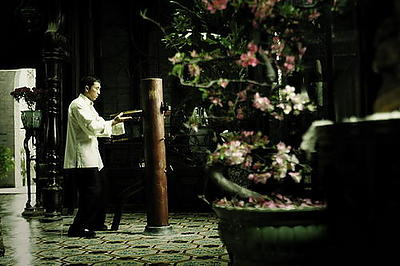
Im Man (original name Yip Man) popularized Wing Chun in Canton and later became famous as Bruce Lee's master. Yip's biopic focuses on the life and times of Ip Man, specifically before and during the Japanese occupation of Fo Shan before Ip Man's ultimate (move to Hong Kong). Although the film takes significant liberties in telling Ip man's story (so much so that Ip Man could fairly be called a work of fiction) Yip's work is not without it pleasures, mainly to be found in the many combat scenes starring Donnie Yen.

In the mid 1930's, Ip Man's home town of Fo Shan has become the cradle of Wing Chun with a huge number of enthusiastic participants and new martial arts schools sprouting up all over the city. Despite the influx of new talent to the city, Ip Man remains the best the city has to offer, regularly vanquishing challengers with ease. His talents earn him the respect of the city's population and the reverent awe of all Wing Chun enthusiasts far and wide. Ip Man's relatively laid back lifestyle is suddenly and irrevocably disturbed as the Chinese mainland is invaded by the Japanese Imperial Army. Ip Man must now fight not for pleasure but to preserve his very way of life.

As a film, Ip Man is a bit of a mixed bag. On the one hand, its action scenes are simply terrific. Donnie Yen gives a physically impressive performance as Ip Man and there really isn't much to criticize when it comes to the action sequences. On the other hand, the narrative often lacks focus and the film tends to meander along at a bit of slow pace until interrupted by a fight scene.Although the plot of a martial arts film is always secondary to it's action sequences, it should nonetheless advance the story or at least provide credibility to the action scenes which the narrative in Ip Man fails to do. Ip Man's life is barely believable, a non-stop succession of mindless duels between Ip Man and various challengers. Although martial arts biopics such as "Dragon: The Bruce Lee Story" often take considerable liberties with their subject's life, "Ip Man" really takes it to another level, essentially telling up nothing about Ip Man besides that he had seemingly never lost a fight with anyone, ever.

Like many films dealing with the Sino-Japanese war, Ip Man drips with bitterness towards the Japanese invaders, painting them as callous, murderous, and unwaveringly evil. Although the Imperial Army certainly had its faults, I find it disappointing to still run across so many films that seem to perpetuate the hurt feelings caused by Japanese military aggression. The generally insensitive handling of Sino-Japanese relations throughout the film appears to closely mirror the continually poor diplomatic relations between Japan and many of its East Asian counterparts. It's a shame, really.

Despite all its faults and culturally insensitivity, Ip Man is not at all a bad film. It's rather quite enjoyable and boast immensely enjoyable martial arts sequences. It's only too bad that Yip couldn't capitalize on the prowess of Donnie Yen to make this a better film.

Love Exposure

A-

Directed by Sion Sono

I must admit that I've never been a huge fan of Fantasia darling Sion Sono, the director of the enjoyable but unspectacular "Suicide Club" and the misanthropic (in my opinion) "Strange Circus." Although Sono's talent is undeniable, I've always felt that he wasted it in pursuit of shock value or cheap thrills. His latest, however, the four hour epic "Love Exposure" is an altogether satisfying and at times brilliant cinematic experience that is as impressive as it is enjoyable.

"Love Exposure" revolves around Yu, a 17 year old boy of a widowed priest. His relationship with his father is to say the least rocky, leading Yu to join a band of hooligans with whom he finds a measure of friendship. At the same time, Yu keeps his eyes open for his soul mate who he had promised his dying mother he would find and present to her. He finally strikes gold when he meets his true love by chance after coming to her rescue (dressed in drag) and fighting off a rival gang of hoodlums. The only problem is that Yoko, his love interest, quickly becomes infatuated with Yu's female persona "Miss Scorpion." Confusion ensues.

The first thing that must be said about "Love Exposure" is that its four hour running time is not only bearable, it flies by. I never found myself looking at my watch or getting up for frequent bathroom breaks. Rather, I was enthralled by Sono's film and too busy watching the story develop to worry about how long I had been sitting in the same seat. "Love Exposure's" length, far from hampering the film, actually helps it insofar as the film's characters are so well developed at the end of its running time that it feels like they could walk of the screen. Even secondary characters such as Yu's father and Koike are given extraordinary depth that likely would have been impossible had Sion Sono's chosen to wittle down the length of the film.
Although it is wacky and irreverent and weird in the manner that all of Sion Sono's films are, "Love Exposure" is also a surprisingly poignant and intelligent study on the nature of love. At one point, Yoko attempts to rid herself of Yu by telling him that he does not know what love is, yelling the words of first Corinthians 13 at him, the irony being, of course, that Yu's love for Yoko throughout the film is, in fact, patient, kind, does not envy or boast and is not proud, but is rather a pure and determined commitment. It's interesting stuff, especially coming from Sion Sono whose character's are often involved in abusive or sexually exploitative relationships. The whole tenor male/female relationships in "Love Exposure" is in fact much different than in Sono's previous works, and his softened view (if you can call it that) appears to be stripped of some of the misanthropy and cynicism found in his previous works, something that I personally find refreshing.
"Love Exposure" is not without many glaring flaws but I nevertheless feel that almost everything that is bad about "Love Exposure" pales in comparison to what is good.

Saturday, July 11, 2009

Dispatches from the 2009 Fantasia Film Festival

It's that time of year again. The Fantasia Festival returns for its 13th year and I'll be there on a semi-regular basis, waiting in lines, watching films, and generally being an unproductive member of society. This year's festival will put a particular emphasis on Hong Kong cinema so I'm quite excited to see some of the films offered. During the first week of the festival I will be watching few notable films including "Thirst," Chan Wook Park's latest, as well as Sion Sono's four hour epic "Love Exposure." I'll hopefully be updating my blog on a more regular basis than I have in the past few months.

Friday, July 3, 2009

Temptress Moon

B-

Directed by Chen Kaige


Chen Kaige, the director of "Farewell my Concubine" (watch it if you haven't already) treads familiar ground with his period piece "Temptress Moon" but somehow delivers an unsuccesful and disappointing film, albeit a beautiful one to look at.

Gong Li plays Pang Ruyi, the sole heir to the Pang Clan's fortune after he brother is incapacitated by an arsenic laced batch of opium. Ruyi, herself an opium user, reluctantly takes over control of the Pang estate with the help of her distant cousin Pang Duanwu. Meanwhile, Ruyi's childhood friend Yu Zhongliang (Cheung) is busy in Shanghai, hustling wealthy women by bedding them and then threatening to reveal the details to their spouses. The two meet up once again when Zhongliang's boss, learning of Ruyi's fortuitious inheritance, sends him to the Pang estate to ply his trade on Ruyi.

Despite enormous potential, "Temptress Moon" never really gets off the ground, moving along at a rather deliberate pace until the film has run out of real estate, so to speak. Leslie Cheung and Gong Li, both immensely talented actors, aren't used very creatively in Chen Kaige's film, Cheung reprising his usual role as the callous ladies man and Gong Li playing the naive beauty, a character she is well accustomed to. What is most disappointing about "Temptress Moon,' however, is that despite the presence of Christopher Doyle (more on him later) and two very talented and magnetic stars in Cheung and Gong Li, Kaige fails to recapture any of the magic of "Farewell my Concubine" despite both film's historical setting and melodramatic overtones. I would argue that it comes down to the script, insofar as "Farewell my Concubine" boasts an extremely focused narrative whereas "Temptress Moon" sort of meanders along, trying to achieve a slow burn but rather losing gas as it sputters along.

Not all is lost, however. "Temptress Moon," as shallow as it is, is nonetheless a pretty sight to behold. Chris Doyle's cinematography is fantastic as always, further reinforcing the point that whatever your film lacks in substance it can make up for in imagery and beauty if you can convince Mr. Doyle to come on board (easier said than done, however, since Doyle isn't exactly a workaholic) Doyle's cinematography is always gorgeous but what impressed me the most about his work in .Temptress Moon' is how creative he gets with his camerawork without (intruding into the story). In one shot, the camera moves along in front of Duanwa as he races through a network of alleyways, then leaves him completely and turns around the corner, panning out on an empty alleyway and leaving Duanwu, who has stopped at a doorway completely out of the frame, until Duanwa reappears a moment later. It's these types of little visual details, subtle yet exciting, that make Doyle's work so consistently fantastic.

Doyle's presence alone saves "Temptress Moon" from mediocrity but it's still far from one of Chen Kaige's most succesful films.

The Slit Mouthed Woman

D-

Directed by Koji Shiraishi

The many remakes of Asian horror films by Hollywood in recent years have given moviegoers the mistaken impression that Asia produces an unending supply of top notch horror flicks that are subsequently butchered by big American studios. Although plenty of this exists, rest assured that a fair share of awful Asian horror films see the light of day every year, 'Slit Mouthed Woman" being one of the worst I've seen in awhile.

"Slit Mouthed Woman" opens with the startling news that a woman, whose mouth is, you guessed it, slit, has been kidnapping children in broad daylight from an otherwise sleepy Japanese suburb. Elementary schoolteacher Kyoko attempts to keep her students away from harm by leading them back to home as a group only to have young Mayumi (I watched this film awhile ago so this may have actually been one of the girl's names...or the name of a male teacher. Whatever.) snatched by the evil Slit Mouthed Woman! A manhunt ensues as the authorities and Kyoko try to find the young boy and the other abducted children.

SMW suffers from woefully substandard production, featuring an amateurish sheen that is acceptable only for student films and intentially B-Rate productions that are trying to make a joke out of their tight budget. The punch to the narrative, if you want to call it that, is both confusing and disappointing, a cop out that would have been more palatable if the lead up to the reveal was worthwhile which, of course, it was not. I feel compelled to give the acting a bit of a pass since most of it is done by children who, truth be told, shouldnt be held to a very high standard of thespian excellence. Nonetheless, I,ve seen my fair share of films feautring untrained child actors and can safely say that this batch of kids is especially bad. The adult actors are no better, and the film's casting is a veritable clinic in how not to cast a movie. All in all, this is a bad, bad, bad, bad movie. Since I feel like I've done my duty by alerting my faithful public to the badness of this movie, and since I don't foresee anyone taking issue with my conclusion that this is, indeed, a very bad movie, I feel comfortable ending this review as it stands now.